Stephen Pepper, "The Work of Art"
&
Edward Bullough, “‘Psychical Distance’ as a Factor in Art
& as an Aesthetic Principle”
Introductory Consideration: EMBODIMENT
Stephen Pepper’s The Work of Art (in Ross’ A&S, pp. 326-330) and Edward Bullough’s “‘Psychical Distance’ as a Factor in Art and as an Aesthetic Principle” (in Ross’ A&S, pp.457-467) will be read in tandem by the Thematic Link: Near or Far? Consummatory Principle & Psychical Distance. Before considering their works in themselves and together, their linkage prompts a consideration of “embodiment.”
Both Pepper and Bullough explore embodied relations as central to considering art experience and judgment (evaluation, critique).
What is “Embodiment” …?:
Embodiment can, perhaps surprisingly, be a very controversial philosophical topic. Consider some of the following situations/issues to work towards an idea of what we do mean by embodiment:
Both Pepper and Bullough explore embodied relations as central to considering art experience and judgment (evaluation, critique).
What is “Embodiment” …?:
- What we don’t mean by this is what comes from overly literal dictionary definitions like ‘tangible ideas or qualities or feelings,’ ‘incarnation,’ ‘incorporation,’ ‘personification,’ etc.;
- instead, take these ideas differently as --the tangible incarnated, incorporated into a person fully realized-- that is, as signs pointing to a sort of thinking that brings (‘incorporates’) into view (‘incarnating,’ ‘tangibly’) the full person (‘personifying’), including rational, physical, and psychical aspects (‘ideas or qualities or feelings’), in conjunction with the context from and to which that person engages … hence, embodying the full, lived picture.
Embodiment can, perhaps surprisingly, be a very controversial philosophical topic. Consider some of the following situations/issues to work towards an idea of what we do mean by embodiment:
- Mind/Body Dualism: ... what most hinders an idea of meaning that comes from embodiment ...
- Origins: From earliest antiquity, there was a privilege of the immaterial over the material, most notable in the idea of how everything that is, must have a cause, so, seeking the origin is to try to get back to what is most original, least duplicated and changeable, hence, to what is most stable, most unchanging, which is, sensibly, what is least material. This divided the material as dubitable from the immaterial as indubitable, hence made a value judgment that the immaterial was most true. Curiously, modern scientific thinking has a tendency to reverse this privilege into a crude 'seeing is believing,' hence putting most weight on what can be empirically demonstrated: the material.
- Soul: Through antiquity, middle ages, into modern and even contemporary periods, variations of mind/body dualism guide our definition of the meaning of being (human, and of all that is). This is well demonstrated in the conception of “soul” as the vital principle of life. For the Greeks, all that ‘lives’ has ‘soul,’ but all that lives can be categorized as a tripartite hierarchy; Aristotle’s version:
- Plants: are alive, hence ensouled with ‘Nutritive’ or ‘Vegetative’ soul that drives growth and reproduction;
- Animals: have ‘Nutritive’ and ‘Sensitive’ levels of soul; in addition to the former’s attributes, the Sensitive part exercises sense-perception, desire, and aspects of ‘motion’ from locomotion (will & power to go from there to here) to imagination and memory (sensory-esque motions of the mind concerning basic levels of self awareness);
- Humans: have ‘Nutritive’ and ‘Sensitive’ and ‘Rational’ levels of soul; in addition to all the former powers, the Rational part exercises all the lower powers of soul plus Nous (mind, understanding, or active intellect and passive intellect). Hence, Aristotle’s definition of humans as “the rational animals.” Found only in Humans, who also have Sensitive and Nutritive parts of soul.
- Aristotle’s conception of soul was adopted with minor modifications as the Abrahamic conception of soul, and you can see how it also influenced all our early and long-lasting scientific conceptions of biological classifications.
- Descartes: So, while long predating him, the early modern René Descartes most radically concretized the divide between the mind and body—his (in)famous conclusion of Cogito, Ergo Sum [I think, therefore I am], establishes the essence, and hence the most certain, trustworthy claim about the meaning of being as thinking, as the mind, which is absolutely not the brain or body. Anything material is suspect, sensory perception tricks us constantly, and hence cannot be relied upon to give us truth. Hence, truth can only be had by the mind, by reason uncorrupted by material experience.
- So … for aesthetics …
- note how dualism makes the “most developed” or “highest” form of life distinct by having/being reason; thus, if we are going to talk about “art” as what comes from humans, as our creative product, we will tend to identify it with what is most mind-like and least body-like. This can yield aesthetic theories that privilege the creator and creating more than the actual creation of art.
- dualism can also effect aesthetics is in requiring the artwork to demonstrably show what makes it art--this is a result of our privilege of reason ... but plays out in two directions:
- First, wherein reason is more modernly defined as what one can demonstrate empirically: hence what makes something good art must be able to be pointed out in the art itself, e.g., the form is balanced, the colors pair well, the chords progress in accord with some rule, etc.
- Second, wherein reason is defined as divorced from the sensible: hence, the most reliable account of aesthetics seeks the idea of art as divorced from its experience as possible: consider it in its definition, as abstracted from its material instantiation as possible. And, if we must talk about the material instantiations, consider then as rationally as possible.
- Phenomenology, Feminism, Race Theory: around 1900, Edmund Husserl’s development of phenomenology (which then birthed existentialism, postmodernism, etc.) radically turned back to a more ancient Greek inspired view of philosophy that sought to erase the disciplinary walls that had been drawn within it (the presumption that things like religion, biology, physics, music, math, etc. were not philosophy’s arena) and reawaken its goal of the good life, which absolutely could not exclude the whole, full, richly lived life, the entire richness of human lived experience, and therefore had to begin from recognition of “embodiment.” In particular, experience is lived experience: dynamic, dependent on a cooperative giving and taking on both the subject and the object's parts. Husserl strove to make his perceptual, sensible, sensual considerations concrete, just as those writing about gender and race strove to avoid reductionism so to recognize the biological givens but not grant them power over meaning, or to try to balance an universal human appeal with conscientiousness of individual humans. The many forms of critical theories thereafter refined and therefore radically expanded how to talk about philosophical issues concerning all aspects of lived experience with direct consideration of the fully lived lives and bodies of the thinkers and that which they thought about.
- So … for aesthetics … consider how our tendencies to especially connect to the material today, to want to reduce things down to what is measurable and exchangeable, might make our aesthetic considerations rely too heavily on ‘body-esque’ aspects of art (give us what we can store in a warehouse archive; sell and resell; copy for more sales; etc.) instead of what ‘embodiment’ means as the far, far more than mere body. How we should be open to the full dynamic flux of meaning wherein contextual factors (market for art by women, minorities; privilege the origin stories more than content; require messages that promote multi-perspectives; dismiss art forms that don’t emphasize ever broader ways of thinking embodiment issues; etc.) are just as important to determining something's meaning and value. We should learn to engage art more like Kandinsky urged us: taste the painting, see the music.
Stephen Pepper’s The Work of Art:
Stephen Pepper’s The Work of Art,
Pepper’s “consummatory principle,” akin to an appetitive drive, grounds both how we experience art and judge it (do art criticism)—hence art’s ‘experiencing and judging’ is as ‘appetites consuming.’
He opens with the example asking you to imagine entering an art gallery--what do you do?: when a work catches your eye, you do not remain far away, but are driven to get closer to it, to find the best position from which to 'consume it' ...
... because, "in a consummatory field of activity a person is drawn to the optimum condition of consummatory response with respect to the object ..." and such, too, is the case with art (326). This is "the consummatory principle. ... the tendency to make the most of the consummatory field" (326).
The Consummatory Principle:
The structure of the consummatory field dictates one's movements within that field in the pursuit and maximization of satisfaction. One does not know the right or wrong moves until they are tried out. One must literally move one's body around in the space, although this space is also dispositionally determined.
The point of all this? Well, at least one of them: "the object of criticism is the terminal area of the optimum receptivity for the vehicle of a work of art" (328).
Pepper's Example: Breughel's "Winter"
Given the lack of noting 'the Elder' or 'the Younger' and the number of winter landscapes between them, it is a little unclear which exactly Pepper has in mind ... but here are a selection:
Pepper’s “consummatory principle,” akin to an appetitive drive, grounds both how we experience art and judge it (do art criticism)—hence art’s ‘experiencing and judging’ is as ‘appetites consuming.’
He opens with the example asking you to imagine entering an art gallery--what do you do?: when a work catches your eye, you do not remain far away, but are driven to get closer to it, to find the best position from which to 'consume it' ...
... because, "in a consummatory field of activity a person is drawn to the optimum condition of consummatory response with respect to the object ..." and such, too, is the case with art (326). This is "the consummatory principle. ... the tendency to make the most of the consummatory field" (326).
The Consummatory Principle:
- a selective system
- like an appetitive drive
- a terminal phase of a positive desire
- First: you are driven to speedily attain the best position from which to appease your desire to consume the aesthetic object
- acts are right or wrong per their proportion to get or not get the consummatory field
- speed dictates the movements
- acts are right or wrong per their proportion to get or not get the consummatory field
- Second: upon attaining the best position, your principle of action changes to then maximize your pleasure in the field
- acts are right or wrong per their proportion to maximize or not the satisfaction in the field
- the longer the enjoyment the better
- acts are right or wrong per their proportion to maximize or not the satisfaction in the field
The structure of the consummatory field dictates one's movements within that field in the pursuit and maximization of satisfaction. One does not know the right or wrong moves until they are tried out. One must literally move one's body around in the space, although this space is also dispositionally determined.
The point of all this? Well, at least one of them: "the object of criticism is the terminal area of the optimum receptivity for the vehicle of a work of art" (328).
Pepper's Example: Breughel's "Winter"
- Pieter Brueghel the Elder (1525/30-1569), a Flemish Renaissance painter whose catalogue includes 40 paintings, 65 drawings, and 89 engravings, many of which are winter landscapes, known for his landscapes and deep humanism of his subjects.
- Pieter Brueghel the Younger[Bruegel--he dropped the 'h' in his name mid-career] (1564-1638), son of Pieter Brueghel the Elder and, like his father (although the father died when he was just five), a painter--actually, one who copied many of his father's paintings, especially landscapes and religious scenes, often featuring peasants in bright, almost bawdy styles.
Given the lack of noting 'the Elder' or 'the Younger' and the number of winter landscapes between them, it is a little unclear which exactly Pepper has in mind ... but here are a selection:
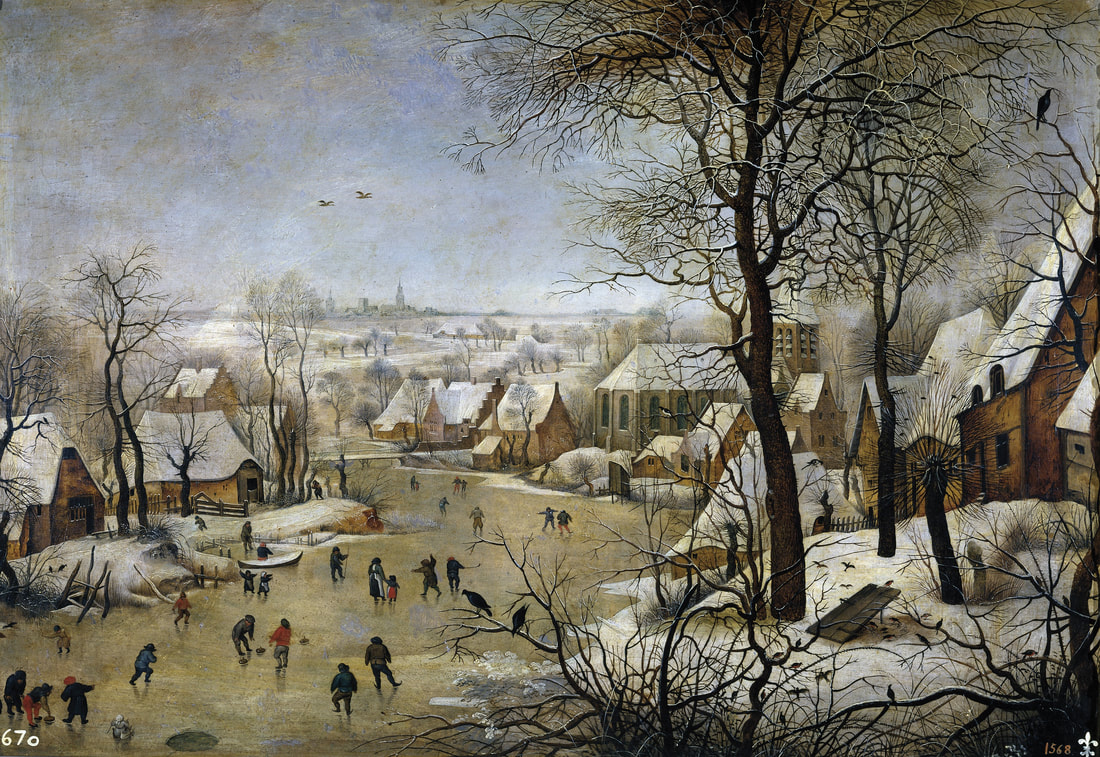




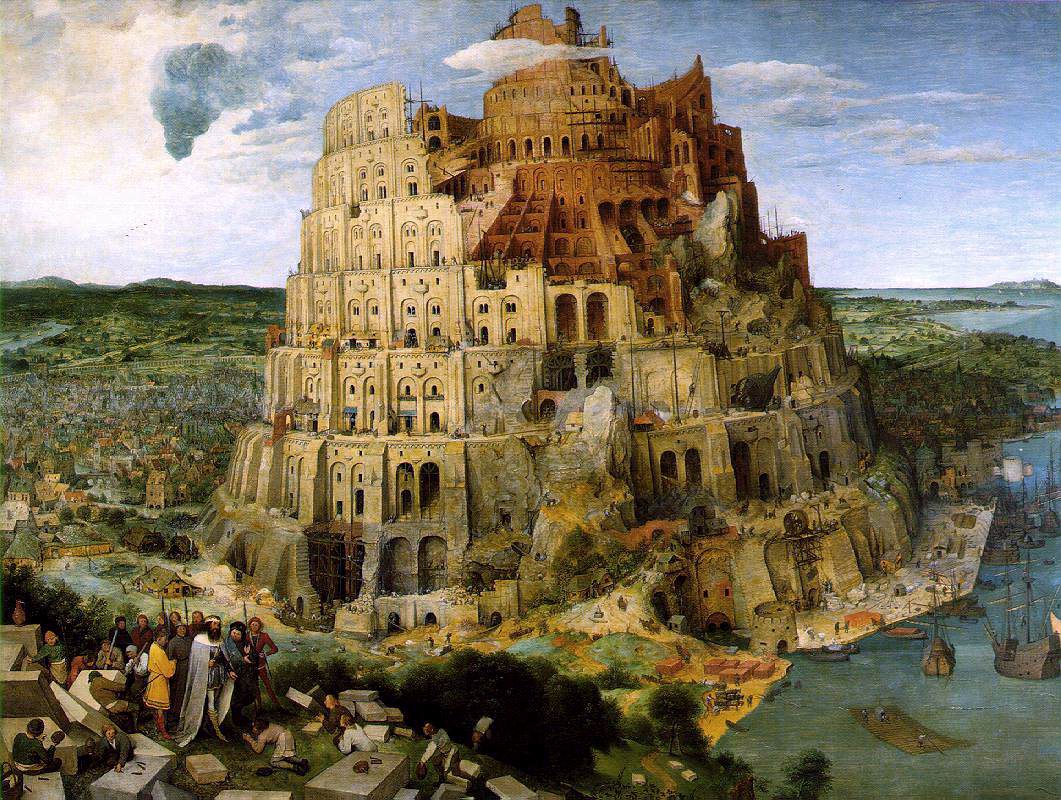


(See ~HERE~ for the Tashen book on Brueghel & ~HERE~ for a video on his Hunters in the Snow & ~HERE~ for a video on Brueghel's winter landscapes)
Using Brueghel's "Winter," Pepper emphasizes that the activity of engaging the work is based on bodily and dispositionally trial and error; he is illustrating that the object of criticism is the best point of appreciation for whatever the work is specifically engaged (e.g., with the painting, it is the point and view wherein one 'connects' most with the key characters in the work):
"When a critic states that Brueghel's Winter is beautiful, he is accordingly referring to a consummatory field and the operation of a selective system within that field. He is referring to an area of optimum receptivity and to the content of response obtainable in that area. He may describe this content of the relevant characters of the fully appreciated picture in great detail. These characters will include the emotions and feelings as well as colors, lines, and representational meanings. He is asserting in declarative terms that this is the response a person will get if he maximizes the relevant satisfactions in this consummatory area" (329).
"The critic is like the helpful guide ..." (329)--that is, the critic doesn't command you to agree with her judgment, nor command you to, e.g., climb up to the ledge to see the waterfall, but is telling you a FACT about the consummatory field and if one fully engages it, the satisfaction that will be yielded.
There are many more questions, Pepper asserts, that must be addressed in the story of responsible art criticism, but these points about the consummatory principle form criticism's basis. And this basis is declarative--it is a series of descriptions that are fact that can be judged true or false--and if followed, will yield what they say.
- The description a critic uses to get the viewer to this and through this experience can be judged true or false (if a review of the painting doesn't acknowledge it is winter, this is a false address) (328).
- The critic's description takes an if-then form, that is, IF the viewer fully engages satisfaction in the consummatory field (attains & maximizes consumption therein), THEN the viewer will be satisfied (agree with the critic about its judgment).
"When a critic states that Brueghel's Winter is beautiful, he is accordingly referring to a consummatory field and the operation of a selective system within that field. He is referring to an area of optimum receptivity and to the content of response obtainable in that area. He may describe this content of the relevant characters of the fully appreciated picture in great detail. These characters will include the emotions and feelings as well as colors, lines, and representational meanings. He is asserting in declarative terms that this is the response a person will get if he maximizes the relevant satisfactions in this consummatory area" (329).
"The critic is like the helpful guide ..." (329)--that is, the critic doesn't command you to agree with her judgment, nor command you to, e.g., climb up to the ledge to see the waterfall, but is telling you a FACT about the consummatory field and if one fully engages it, the satisfaction that will be yielded.
There are many more questions, Pepper asserts, that must be addressed in the story of responsible art criticism, but these points about the consummatory principle form criticism's basis. And this basis is declarative--it is a series of descriptions that are fact that can be judged true or false--and if followed, will yield what they say.
"The things you see, the rustle, crackling, and tones you hearken to, the roughness and the sleekness you touch are not just pieces of a puzzle you have to understand. In fact there are no intelligible concepts that grasp the languorous liquidity of the water in the bath, the tang of lemonade, the velvety green of springtime, the foolishness of a kitten rolling a ball in the sidewalk and tumbling over itself"
-- Alphonso Lingis, “Contact,” Janus Head 8, 2 (2005): pp. 439-54, p. 452.
Edward Bullough’s “‘Psychical Distance’ as a Factor in Art and as an Aesthetic Principle:"
Edward Bullough’s “‘Psychical Distance’ as a Factor in Art and as an Aesthetic Principle,”
I. (pp.458-61)
1. (pp.458-60): Distance in general --> Psychical Distance
Distance we are not talking about: Thinking of ‘distance’ in regards to art may invoke issues of actual spatial distance (e.g., audience to the work of art), represented spatial distance (e.g., foreground to background depth in a work), or temporal distance (e.g., contemporary interpretations of ancient works). These are not what we are considering, but are special types of the broader aesthetic idea of distance we are pursuing.
Distance we are focusing on here: Psychical Distance. Psychical distance is distance in general aesthetically considered but not so specifically as to be the specialized types noted above.
Bullough’s explanatory (of Psychical Distance) example:
Imagine fog at sea. The experience is unpleasant: you cannot see clearly, it may delay your travel, but more importantly, it may generate anxiety, fears of what is unseen, of not being able to see well, the sense of possibility missing signals, it is silent and gentle, listless, but stresses you, your eyes, ears, alights your worry; the experience wears your nerves, the anxiety expands into a more global, ideal ‘dread of the sea’.
Now, abstract yourself from imaginatively embodying the experience of the fog at sea. Abstract yourself from fears of imminent danger and practical unpleasantness. Direct your attention to everything “objectively” constituting the phenomenon: the fog as a occluding milky veil; outlines of things blurred into monstrous shapes; how the air moves and makes you feel as if you could touch a distant reverberation of a fog horn; the smooth texture of the water around you; the strangeness of this world, the solitude and remoteness it creates, distancing you from the world. –this abstraction and redirection of your attention shows “the experience may acquire, in its uncanny mingling of repose and terror, a flavour of such concentrated poignancy and delight as to contrast sharply with the blind and distempered anxiety of its other aspects” (p.459).
I. (pp.458-61)
1. (pp.458-60): Distance in general --> Psychical Distance
Distance we are not talking about: Thinking of ‘distance’ in regards to art may invoke issues of actual spatial distance (e.g., audience to the work of art), represented spatial distance (e.g., foreground to background depth in a work), or temporal distance (e.g., contemporary interpretations of ancient works). These are not what we are considering, but are special types of the broader aesthetic idea of distance we are pursuing.
Distance we are focusing on here: Psychical Distance. Psychical distance is distance in general aesthetically considered but not so specifically as to be the specialized types noted above.
Bullough’s explanatory (of Psychical Distance) example:
Imagine fog at sea. The experience is unpleasant: you cannot see clearly, it may delay your travel, but more importantly, it may generate anxiety, fears of what is unseen, of not being able to see well, the sense of possibility missing signals, it is silent and gentle, listless, but stresses you, your eyes, ears, alights your worry; the experience wears your nerves, the anxiety expands into a more global, ideal ‘dread of the sea’.
Now, abstract yourself from imaginatively embodying the experience of the fog at sea. Abstract yourself from fears of imminent danger and practical unpleasantness. Direct your attention to everything “objectively” constituting the phenomenon: the fog as a occluding milky veil; outlines of things blurred into monstrous shapes; how the air moves and makes you feel as if you could touch a distant reverberation of a fog horn; the smooth texture of the water around you; the strangeness of this world, the solitude and remoteness it creates, distancing you from the world. –this abstraction and redirection of your attention shows “the experience may acquire, in its uncanny mingling of repose and terror, a flavour of such concentrated poignancy and delight as to contrast sharply with the blind and distempered anxiety of its other aspects” (p.459).
|
“This contrast, often emerging with startling suddenness, is like a momentary switching on of some new current, or the passing of ray of a brighter light, illuminating the outlook upon perhaps the most ordinary and familiar objects—an impression which we experience sometimes in instants of direct extremity, when our practical interest snaps like a wire from sheer overtension, and we watch the consummation of some impending catastrophe with the marveling unconcern of a mere spectator” (p.459). This shifted perspective is possible due Psychical Distance. |
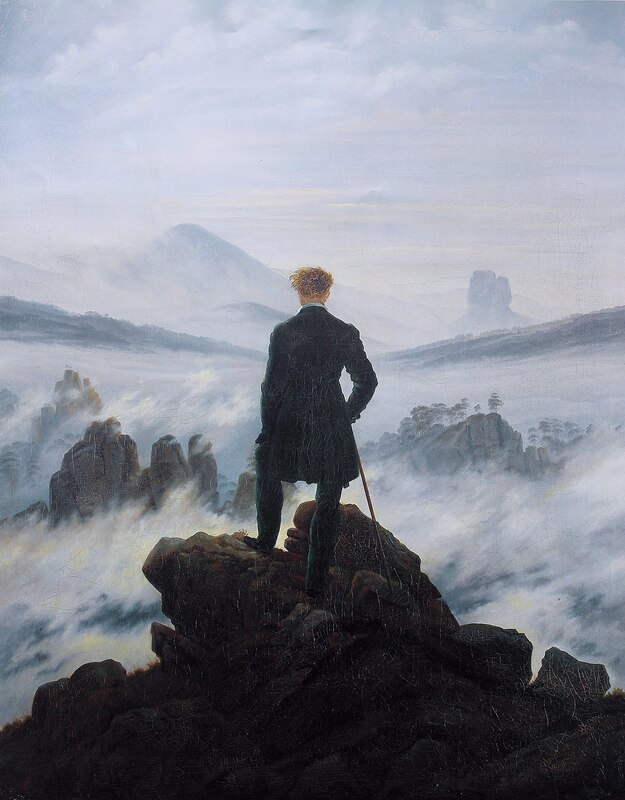
Caspar David Friedrich, Wanderer above the Sea of Fog, 1818, Kunsthalle, Hamburg, Germany
|
Psychical Distance is the standing-out-side-of-your-self happening that permits the radical transformation of experience that permits a radical new illumination. Bullough explains—with the necessary use of scare quotes to alert us to proceed cautiously—that this is imposing an “objective” eye to what the experience gives and affects, so much that even our “subjective” responses to the happening are viewed as “objective” as if all this belonged to the phenomenon happening. We distance ourselves from it and ourselves so to view from outside the whole phenomenological happening as happening, not with and as to us: just simply happening. As mere-happening, its presentation is wholly, radically transformed.
Positive and Negative Aspects to Psychical Distance: This distance is complex; it has positive and negative dimensions. The negative is to be read as “inhibiting” (i.e., not just ‘bad’); the positive is to be read as “elaborating” (i.e., not just ‘good’). So, the negative is the inhibiting, the cutting out, the abstraction of the immediate, practical aspects of things and the immediate, practical attitude we have to them. The positive side is the elaboration that can now fill in the space the negative created, what is filled in here is the description of the transformed experiencing.
2. (p.460): Psychical Distance & Art
Psychical Distance is not our everyday perspective or attitude or way of engaging and experiencing the world. The radical difference it provides—this sudden new view—is revelations of art. Thus, Art is the revelation of the unexpected sides of experience. Psychical Distance, thus, is us factor in all art.
3. (pp.460-61): Psychical Distance as Aesthetic Principle
Psychical Distance is (also, thus) an aesthetic principle. This means and thus implies three things:
Positive and Negative Aspects to Psychical Distance: This distance is complex; it has positive and negative dimensions. The negative is to be read as “inhibiting” (i.e., not just ‘bad’); the positive is to be read as “elaborating” (i.e., not just ‘good’). So, the negative is the inhibiting, the cutting out, the abstraction of the immediate, practical aspects of things and the immediate, practical attitude we have to them. The positive side is the elaboration that can now fill in the space the negative created, what is filled in here is the description of the transformed experiencing.
2. (p.460): Psychical Distance & Art
Psychical Distance is not our everyday perspective or attitude or way of engaging and experiencing the world. The radical difference it provides—this sudden new view—is revelations of art. Thus, Art is the revelation of the unexpected sides of experience. Psychical Distance, thus, is us factor in all art.
3. (pp.460-61): Psychical Distance as Aesthetic Principle
Psychical Distance is (also, thus) an aesthetic principle. This means and thus implies three things:
- (a) When we really understand Psychical Distance, we see that it is a fundamental aesthetic principle that is the synthesis of all aesthetic opposites (e.g., “objective” and “subjective,” etc.).
- i.e., Psychical Distance is dubbed “objective” viewing, but we must rethink what we mean when we talk of “objective” and “subjective” aesthetic perspectives. “Objective” and “subjective” are opposites, but art can never be wholly one or the other (and, besides, how these are used is always confused). Similarly, ideal/real, sensual/spiritual, individual/typical—all these contraries should be regarded warily.
- n.b., as to “synthesis”—think Hegelian dialectic here! Opposites (thesis vs. antithesis) are mediated in the synthesis which also preserves elements of both while combining and uplifting them to a higher level of development.
- (b) Psychical Distance is also a necessary criterion for the judgment of the Beautiful (esp. as distinct from the ‘agreeable’ or ‘pleasant’).
- (c) Psychical Distance is also one of the essential characteristics of ‘aesthetic consciousness’.
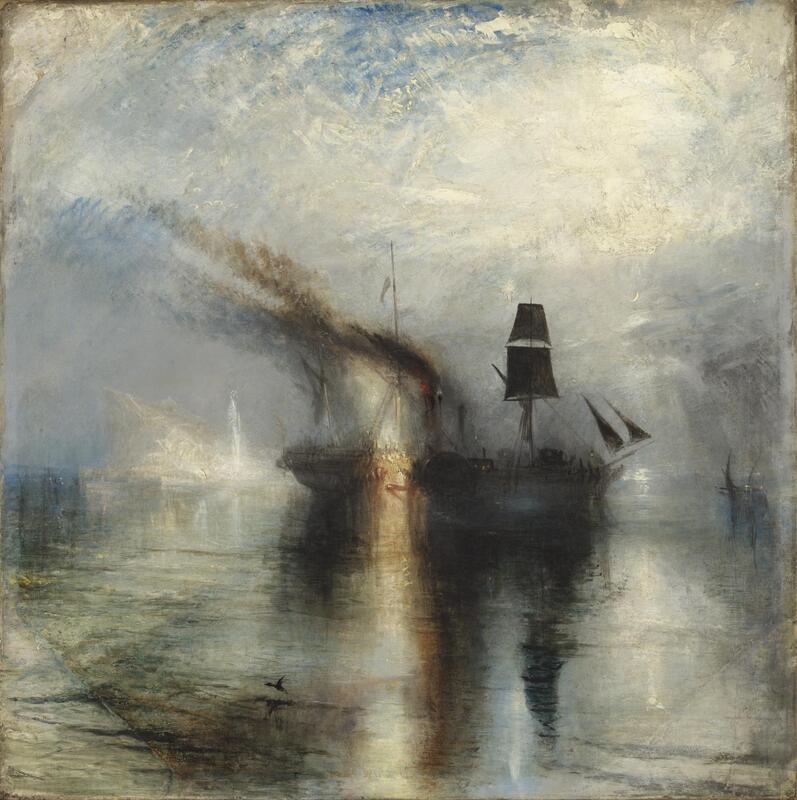
JMW Turner, Peace -- Burial at Sea, 1842, Tate
|
" ... direct the attention to the features 'objectively' constituting the phenomenon--the veil surrounding you with an opaqueness as of transparent milk, blurring the outline of things and distorting their shapes into weird grotesques; observe the carrying-power of the air, producing the impression as if you could touch some far-off siren by merely putting out your hand and letting it lose itself behind the white wall ..." (459) |
II (pp.461-67)
- “Distance … is obtained by separating the object and its appeal from one’s own self, by putting it out of gear with practical needs and ends. Thereby the ‘contemplation’ of the object becomes alone possible. But it does not mean that the relation between the self and the object is broken to the extent of becoming ‘impersonal’” (462).
Psychical Distance permits the ‘contemplation’ of the ‘object’ alone--but this doesn’t mean that the self-object link is broken and the contemplation ‘impersonal.’ Like the other opposites discussed above, forget about the strict dichotomy and confused understandings of ‘personal’ and ‘impersonal.’
When Bullough speaks of the ‘impersonal’ and ‘objective’ dimensions Psychical Distance permits, he is speaking of the unique and fundamental aesthetic principle of distance and unique relationship between the spectator and artwork. Thus:
1. (pp.461-62):
- “Distance does not imply an impersonal, purely intellectually interested relation … On the contrary, it describes a personal relationship, often highly emotionally coloured, but of a peculiar character” (461).
The peculiarity here is a sort of filtering. For example: drama …
- Think of the attitude you bear to events and characters in a drama … they strike us as normal people and situations, but our directly personal manner towards them is held in abeyance. We know fictional drama is unreal, yet we suspend this enough so to let ourselves engage it.
- Bullough cites a similarity here to Witasek and Meinong’s theory of Annahmen—‘assumptions’—the emotions we bear in relation to watching a drama as Scheingefühle—quasi-emotions, the translucent feelings, feelings called forth by appearances (schein—lights, shadows, glimmerings, shimmerings, glow). BUT, he insists … :
- The real situation is that the ‘assumption’ (partial subsumption of our everyday personal, direct manner towards drama) we make so to view art in this way is more so the consequence of Psychical Distance. …
This is the seeming paradox of Psychical Distance: it gives us the appearance of unreality … it changes our relation to drama so to give them their seeming unreality or fictitiousness (and not the inverse: it is not fictitiousness that seemingly alters our relations to them).
2. (pp.462-63):
The Antinomy of Distance—one of the fundamental paradoxes of art.
- –Concordance: Art is more likely to appeal to us if we are prepared for that sort of appeal. (With no predisposition on our part, the art will remain incomprehensible and thus unappreciated.)
- –Distance: But distance is also required, or else we will be too ego-centrically attracted and lose the ability to actually appreciate the work as a work of art.
- E.g.: Shakespeare’s Othello--
- –starting the ill-fated drama, Othello and Desdemona secretly wed. Roderigo is in love with Desdemona; he tells a mate, Iago, of his furious sorrow. Iago himself bears a great grudge against Othello for having promoted the younger Cassio over him. Roderigo and Iago thus plot against Othello. First, they betray to Desdemona’ father a story of his daughter’s elopement; charges are laid against Othello, who overcomes them, arguing stories of his past, not witchcraft, made Desdemona fall in love with him—but the seeds of doubt are planted in Othello: for she deceived her own father, why think she would not deceive him? Next, a misplaced handkerchief is used to frame Desdemona for adultery. Enraged, Othello kills Desdemona—although her deathbed words are a defense of her husband shared with Iago’s wife. Iago’s wife realizes the actions of her man, betrays his authority and tells of his treachery—and is killed by him for it. Othello finally realizes his error, sees the truth; he fights and wounds Iago, and they are both arrested for the two murders. Othello kills himself; Iago is then punished by the man Cassio, who sparked his grudge in the first place. {See ~here~ for text of Othello and other resources}
- Imagine a man going to see Othello who doubts the fidelity of his own wife. By the principle of concordance, we would believe him most properly given to have the play best appeal to him … but, no … he ought to, but does he not actually render himself incapable of appreciating the play because it does nothing but further stoke the fires of his own jealousy. He sees no actors, but his self and wife; he hears no drama, save his own story. “This reversal of perspective [self & self’s story over Shakespeare’s] is the consequence of the loss of Distance” (462).
- E.g.: Shakespeare’s Othello--
Hence, the Antinomy of Distance necessitates that “the coincidence should be as complete as is compatible with maintaining Distance” (462).
|

|
The Antinomy of Distance is required by:
“What is therefore, both in appreciation and production, most desirable is the utmost decrease of Distance without its disappearance” (463).
3. (pp.463-67): Variability of Distance: Presupposition to the Antinomy of Distance
Distance admits of degrees. These degrees of variability differ according to:
–The Nature of the Object, which may impose greater/lesser degree;
–The Individual’s Capacity for maintaining greater/lesser degree.
These will differ between individuals and within one individual as she faces different objects in different arts.
Thus … there are two sets of conditions affecting Distance:
–Those Offered by the Object
–Those Realized by the Subject
Further … There are two ways of losing Distance:
In theory, there is no limit to the decrease of distance; in practice, there is, but it is impossible to fix exactly what it is.
- Viewer: as the example of the spectator to Othello;
- Critic: Criticism is an art itself precisely because of the challenges of maintaining the not too much, not too little at once with their expert knowledge and critical professionalism;
- Artist: and the artist, too, must work from the most personal depths, but to actually portray such, she must have enough distance.
“What is therefore, both in appreciation and production, most desirable is the utmost decrease of Distance without its disappearance” (463).
3. (pp.463-67): Variability of Distance: Presupposition to the Antinomy of Distance
Distance admits of degrees. These degrees of variability differ according to:
–The Nature of the Object, which may impose greater/lesser degree;
–The Individual’s Capacity for maintaining greater/lesser degree.
These will differ between individuals and within one individual as she faces different objects in different arts.
Thus … there are two sets of conditions affecting Distance:
–Those Offered by the Object
–Those Realized by the Subject
Further … There are two ways of losing Distance:
- –Under-Distance: most common failing of a subject (e.g., get too wrapped up; i.e., deficiency of distance makes art feel crudely naturalistic, too harrowing, repulsive in its realism)
- –Over-Distance: most common failing of an art object (e.g., esp. due past, history, temporal distance; i.e., excess of distance makes art feel artificial, empty, improbable, absurd)
In theory, there is no limit to the decrease of distance; in practice, there is, but it is impossible to fix exactly what it is.
- Typically, we can see these more clearly in under-distancing art rife with sexual allusions and over-distancing in art rife with social institution allusions.
Several Broad Reading & Discussion Prompts to Consider:
Near & Far: Both Pepper and Bullough tie art experience and judgment to nearness and farness, with the former emphasizing the coming-near and the latter the keeping-far. Their approaches (emphasizing exactly the idea of approach) are simple and radical at once: of course the human body in spatio-temporal positioning and human mind in reflective-attentive-anticipatory relation to art fundamentally impacts experience and evaluation … but these are also insights that many try so hard to suspend in or abstract from art experience and evaluation in order to try to get to something essential, objective, universal, true, reliable, knowable, etc. about art. What do you think are the best points (in the thinkers and your own) for and against including and excluding embodiment (near-far as mind/body-art relation) in aesthetics?
Consummation & Pleasant: Pepper’s “consummatory principle,” akin to an appetitive drive, grounds both how we experience art and judge it (do art criticism)—hence art’s ‘experiencing and judging’ is as ‘appetites consuming.’ This sounds like Kant’s judgment of the “pleasant”—hence, more akin to our regard of sandwiches and cakes, scary movies on Halloween and fluffy comedies after bad days. How does the consummatory principle identify with and differ from our judgment of the pleasant? Since Pepper believes his theory is not a radically personal relativism (in which every experience and critique would be valid only for the one doing it), what structure or guide does he give it to keep it from this, and do you think he succeeds?
Distance &/vs. Disinterest: Bullough’s idea of “psychical distance” can be read as a revision or refinement of Kant’s idea of “disinterest” as a requirement for true aesthetic judgments. (a) Identify several key factors that explain Bullough’s distance, (b) argue how they do or do not differentiate it from Kant’s disinterest, (c) then personally evaluate the idea of “psychical distance” as “the much needed criterion of the beautiful” (460, emphasis mine).
Objective/Subjective: We struggled in Kant to come to terms with his declaration of aesthetic judgment as subjective and universal. Part of that struggle to evaluate it required us to better understand what those characteristics meant. Bullough deals with the same difficulty of loose and specific meanings of objective and subjective. Since there are differences and similarities, elaborate what these ideas mean and how they play roles in the aesthetic theories of both thinkers, and conclude with your own thoughts whether one thinker’s ideas can help us think of the other’s ideas.
Consummation & Pleasant: Pepper’s “consummatory principle,” akin to an appetitive drive, grounds both how we experience art and judge it (do art criticism)—hence art’s ‘experiencing and judging’ is as ‘appetites consuming.’ This sounds like Kant’s judgment of the “pleasant”—hence, more akin to our regard of sandwiches and cakes, scary movies on Halloween and fluffy comedies after bad days. How does the consummatory principle identify with and differ from our judgment of the pleasant? Since Pepper believes his theory is not a radically personal relativism (in which every experience and critique would be valid only for the one doing it), what structure or guide does he give it to keep it from this, and do you think he succeeds?
Distance &/vs. Disinterest: Bullough’s idea of “psychical distance” can be read as a revision or refinement of Kant’s idea of “disinterest” as a requirement for true aesthetic judgments. (a) Identify several key factors that explain Bullough’s distance, (b) argue how they do or do not differentiate it from Kant’s disinterest, (c) then personally evaluate the idea of “psychical distance” as “the much needed criterion of the beautiful” (460, emphasis mine).
Objective/Subjective: We struggled in Kant to come to terms with his declaration of aesthetic judgment as subjective and universal. Part of that struggle to evaluate it required us to better understand what those characteristics meant. Bullough deals with the same difficulty of loose and specific meanings of objective and subjective. Since there are differences and similarities, elaborate what these ideas mean and how they play roles in the aesthetic theories of both thinkers, and conclude with your own thoughts whether one thinker’s ideas can help us think of the other’s ideas.