Being and Time: an introductory sketch and broad overview
Heidegger’s Being and Time [Sein und Zeit] was published in 1927; it was rushed to publication in his attempt to secure a full time position teaching philosophy, and was, therefore, published incomplete (absent the last section of his first division and the whole second division that had been planned, which was to be a devastating critique of the traditional account of ontology (the study of being)). This book, nevertheless, was a phenomenal success, an exciting, radical ‘game changer’ in philosophy. It has had a profound impact on the course of contemporary philosophy and many other areas of study; equally, a lightning rod of criticism predominately complaining it is full of jargon, hence incomprehensible, hence not important—which is simply foolish. The rarer, subtle criticism (e.g., that it over privileges presence, that it under values the degree of the meaning of the flesh in doing ontology, etc.) is somewhat Heidegger’s own from years after Being and Time’s publication, and valuable.
But, let us start to get a grasp on what Being and Time is actually all about. We’ll do so by looking at the title: Sein und Zeit [Being and Time].
- das Sein:
- sein is the infinitive, “to be.” In German (and many languages, although very rarely in English), we can transform the infinitive, which is used as a verb, into a noun, hence das Sein (German nouns are all and always capitalized). To translate das Sein into English, we would typically say “being;” to transliterate it, that is, to literally translate it, we would say “the to be.” The transliteration is very awkward, but much closer to what Heidegger means by das Sein.
- Das Sein, for Heidegger, does not mean beings in the sense of Sally, Jose, or Zelda,* nor does it mean beings in the sense of any and all things in being,** nor does it mean Being in the sense of a or the divine being.
- * This would be more like “existant.”
- ** This would be more like das Seiende, “entity.”
- Instead, for Heidegger, das Sein is more like “the to be” in the sense of “the meaning of being,” but this requires us to better understand the meaning of “meaning” [sinn].
- Sinn:
- For Heidegger, “meaning” [sinn] means: that from which something is understandable as the thing it is. To better understand this meaning of “meaning,” we have to think phenomenologically … which I’ll start to introduce through an adaptation of an illustration given by Magda King in her A Guide to Heidegger’s Being and Time (ed. John Llewelyn (Albany: SUNY Press, 2001), 6-7):
- Imagine that you are a stranger in a town and come across an unfamiliar building. You ask a passer by what it is. The stranger tells you it is a stage. On the one hand, you now know what this building is: a stage—“the building has explicitly come to our understanding” as being a stage; on the other hand, you are uncertain what “a stage” is or might be, hence you ask a clarifying question: what is a stage? The stranger tells you that it is a place where they perform Trauerspiels, which are tragic dramas played out as an art form by actors for audiences. Now, this building “has become manifest in what it essentially is,” that is, we now understand what this building is as the thing it is essentially. However, where, in this explanation of the thing, is its precise meaning? It is not in the word “stage.” It is not in the physical bricks and mortar and wood boards. The meaning somewhat rests in the explanation of its purpose: what is this thing for? This “for” points to purpose, but also to more than that, for it also points to the “who” that asks and the greater “who” of the environment or world in which it is situated. Meaning only comes from the “from which something is understandable”—that is, from the world of human existence. In this world, the essential being of the thing can be known as it is for this world. (This shows us that the question of the meaning of being is the fundamental question, even prior to questions of “that it is” or “what it is.”)
- For Heidegger, “meaning” [sinn] means: that from which something is understandable as the thing it is. To better understand this meaning of “meaning,” we have to think phenomenologically … which I’ll start to introduce through an adaptation of an illustration given by Magda King in her A Guide to Heidegger’s Being and Time (ed. John Llewelyn (Albany: SUNY Press, 2001), 6-7):
-
- So! If das Sein means something like “the meaning of being,” and “meaning” means “that from which something is understandable as the thing it is,” his and our object of study is going to be the meaning of essential being that is what it is essentially by its embeddedness in the world, and not in a substantial (as a substance) way, and not statically, but dynamically so. This dynamism hearkens the second part of his title, Zeit, “Time,” and also illustrates another phenomenological principle.
- Zeit:
- Not to give away some sort of great answer of the book, but, basically: being is time. This is hardly simple. “Being” is what has been sketched above: being is the question of the meaning of being [die Frage nach dem Sinn von Sein], which is also the same as saying being is to question what it means to be [die Frage nach dem Sinn von Sein—yes, the German is identical], which is also the heart, thesis, and entire project of the book. “Meaning” invokes the whole context from which essential being comes; this context is dynamic: it changes; “meaning,” then, is also a verb-like command of activity. In parallel, “Being” is also “the to be” in that it is what it means to be. Being is what is dynamically stretched between the past, present, and future, and is for all of these. This will be more clear with a brief overview of phenomenology.
Contextualization with Phenomenology:
To understand Heidegger’s importance in the philosophical canon, and what Being and Time is about, we need to understand his and its relationship with Edmund Husserl’s phenomenology and then between it and existentialism.
Edmund Husserl (1859-1938):
... is the father of phenomenology, while his studies included astronomy, mathematics, physics, and the history of philosophy with emphases on logic and philosophy’s relation to psychology, especially intentionality and perception. Husserl taught philosophy at Freiburg until his retirement in 1928, when his successor was his former student and assistant, Heidegger. Shortly after his retirement, with the rise of Hitler, Husserl’s Jewish parentage incurred him much humiliation and shunning from the German intellectual community. He did not, however, flee Germany; he died in Frieburg in 1938. Immediately upon his death, his manuscripts were smuggled out of Germany to Leuven, Belgium, where his archives (of over 40,000 pages) are now established.
Husserl’s phenomenology is both a celebrated school of contemporary Continental philosophy and a primarily epistemological method that he envisioned as applicable to widely diverse areas of study. Phenomenology is, literally and etymologically derived, the study of phenomena. Phenomena is all that is that appears to us (its opposite is the noumena, that which does not, cannot, appear to us—Kant is most famous for developing the analysis of the noumena in his First Critique). Phenomenology, as this study of phenomena, is founded upon the premise that one can reliably capture and describe experience, from which meaning, and hence our knowledge, comes. Phenomenology’s coda—that the world gives itself to us as we give ourselves to the world—locates the creation of meaning in this communal giving and indicates a mode of experience wherein our presumptions of having an egoistic supremacy over an essentially independent world (in which we are its sole interpreter and judge of its value) are unsettled.
This being unsettled, this suspension of bias, called the epoché, is what switches us from our Natural Attitude (the everyday reality in which we live our day to day lives) to the Phenomenological Attitude (the attitude wherein one moves from a recognition of the everyday world to the world as an object for study and the self, too, as an object for study; this is like viewing everything with child’s eyes, pure, fresh, without bias).
In the phenomenological attitude, three elements change:
- experience,
- In experience, the flatness of the natural attitude’s Erfahrung, wherein things appear as substances with properties, gives way to the phenomenological Erlebnis, a dynamic, lived experience.
- intentionality,
- In intentionality, the natural attitude gives the world as seemingly distinct and independent; the phenomenological attitude shows intentionality to be relational, how I am to it and it is to me.
- In intentionality, the natural attitude gives the world as seemingly distinct and independent; the phenomenological attitude shows intentionality to be relational, how I am to it and it is to me.
- reflection.
- In reflection, the natural attitude experiences this as a break and redirection of attention from the object to the subject; in the phenomenological attitude, all consciousness is revealed to be implicitly reflective (I am intuitively aware of the reflexive, meaningful relation between the subject and object, me and it).
While the method operates through a process of abstraction (the epoché, the suspension of bias that allows us to see the things themselves), phenomenology is a study of lived experience; it begins and ends with the subject thoroughly embedded in the world, embodied, and actively engaged with his or her environment. Its demand for the attentive focus of our gaze cultivates multi-dimensional observation (seeing phenomena in its many different horizons, or perspectives, through which it can and does give itself to us) that inspires us to see potential while suspending preconceived ideas. Its resultant contemplation gives us an ethical goal and reveals the steps along a path from reality to the attainment of that ideal.
{{SEE HERE FOR MORE ON phenomenology}}
Heidegger’s Advancement to a Phenomenological Ontology:
Heidegger, Husserl’s most famous student, then took up his master’s method to closely investigate ontological questions—those about being and existence. He wanted to study Being by examining how phenomena become present to human consciousness so as to better understand the question 'what is Being?'
He adopts, with some revision, Husserl’s starting distinction of the Natural Attitude from the Phenomenological Attitude, calling the former the Ontic and the latter the Ontological.* His object of study is the Ontological Attitude—he wants to understand Being itself, not just an individual being (Bobby, Suzy, etc.), so he abstracts away the personal qualities to reveal the ontological essence (the structures of human existence that make possible an understanding of Being) he calls Da-sein.
- * Heidegger will utilize these two attitudes a lot, but how we get to their first distinction, and first important revelation about them, for him is by the distinction between that which is “Ready-to-Hand” and that which is “Present-to-Hand.” Something that is “Ready-to-Hand” is the natural attitude wherein things are just instantly there, we simply use things, we don’t think about it, just use stuff. This is the attitude of practice of praxis if we were to make its distinction from theory. The “Present-to-Hand,” then, is the theory side, like the phenomenological attitude, wherein we have to stop and think about something, for example, because in the everyday suddenly we discover that something is broken, missing, or our use is otherwise impeded. What is utterly crucial here is that Heidegger (radically) inverses our typical presumption of theory and practice. Typically, we presume that we think about something, then do it. Instead, Heidegger shows that we primordially do things, and that to stop and think requires some trigger, like Husserl’s epoché, which breaks us from the everyday use and throws us into reflection. Thus, this reversal of theory/practice reveals Da-sein as primordially involved in things, which points us to our Throwness.
- Dasein [or, Da-sein]: The being for whom Being is a question--i.e., the person (being) who thinks about the meaning of his/her Being (of the essence of what it means to be):
- “Da-sein is a being that does not simply occur among other beings. Rather it is ontically distinguished by the fact that in its being this being is concerned about its very being” (Heidegger, Being and Time, 12—in his original pagination).
- Heidegger coins this word from the conjunction of the German Da (“there”) and Sein (“being”), so it is literally “there-being,” or, that being there. It is important to note that while Da-Sein sounds like a dramatic abstraction, it is fully engaged in the essential everydayness of life—not the specifics as to whether you are male or female, young or old, but what any living human being experiences; it is not the idea of a single “soul,” but Being as a “happening” [Ereignis], or life as the event that it is. When we begin from this essential living, we reveal the totality of our existence: our moods, our capacity for authenticity, and our involvement with the world and others. Hence … Dasein is the object of our phenomenological-ontological study of Being; it is ontic, because we want to know about the Being of beings, but it is not the Being of Sally or Jimmy, because that would be too specific, and may not reveal the essential meaning of Being that we all share … so, let’s better explicate these terms:
-
- Ontology: The study of being, from the Greek to on (“to be”) plus logos (meaning ‘the study of’). This is one of the branches of philosophy, alongside others like metaphysics (the study of being and reality), epistemology (the study of knowledge), ethics, logic, etc.
- … BUT … Heidegger is doing ontology, studying being, but proceeds to do so by dividing ‘being’ into two categories (and one derivative or qualified category):
- Ontology: The study of being, from the Greek to on (“to be”) plus logos (meaning ‘the study of’). This is one of the branches of philosophy, alongside others like metaphysics (the study of being and reality), epistemology (the study of knowledge), ethics, logic, etc.
-
- The Ontological: [of Being] this designates being itself, the essence of Being (shared by all beings). There is a parallel here to Gilson’s “philosophical” questions (e.g., the how it is that something is, or that something is at all).
-
- The Ontic: [of beings] this designates the everydayness of beings. There is a parallel here to Gilson’s “scientific” questions (e.g., what this thing is).
-
- The Pre-Ontological: (the derivative category) this designates an even more everydayness of beings wherein one isn’t even thinking scientifically about anything, but simply in the flow of life and not thinking about it.
Thus, Da-sein is a human being who is always already embedded in the world and inherently social (is the three existentiells: being-in-the-world, being-towards-death, and being-with, as described more below) and is naturally operating with a preontological (there, but there before theoretical reflection) grasp of the a priori structures of Being (the prior-to-experience, inherent structures of the Being of beings, described below as the “care structure”) that make the adoption of particular modes of Being possible (the underlying structures of Being that make it possible to be these beings we are in the many different ways we can be). “… [I]t is constitutive of the being of Da-sein to have, in its very being, a relation of being to this being. And this in turn means that Da-sein understands itself in its being in some way and with some explicitness. It is proper to this being that it be disclosed to itself with and through its being. Understanding of being is itself a determination of being of Da-sein. The ontic distinction of Da-sein lies in the fact that it is ontological. … We shall call the very being to which Da-sein can relate in one way or another, and somehow always does relate, existence [Existenz]” (Heidegger, B&T, 12).
Thus, Da-sein is a human being who is always already embedded in the world and inherently social (is the three existentiells: being-in-the-world, being-towards-death, and being-with, as will be explored in depth as the text proceeds) and is naturally operating with a preontological (there, but there before theoretical reflection) grasp of the a priori structures of Being (the prior-to-experience, inherent structures of the Being of beings, that will also be explored as the text proceeds through the “being-in-as-such” structure of Attunement, Understanding, Discourse, and Entanglement, then the “care structure,” ) that make the adoption of particular modes of Being possible (the underlying structures of Being that make it possible to be these beings we are in the many different ways we can be). “… [I]t is constitutive of the being of Da-sein to have, in its very being, a relation of being to this being. And this in turn means that Da-sein understands itself in its being in some way and with some explicitness. It is proper to this being that it be disclosed to itself with and through its being. Understanding of being is itself a determination of being of Da-sein. The ontic distinction of Da-sein lies in the fact that it is ontological. … We shall call the very being to which Da-sein can relate in one way or another, and somehow always does relate, existence [Existenz]” (Heidegger, B&T, 12).
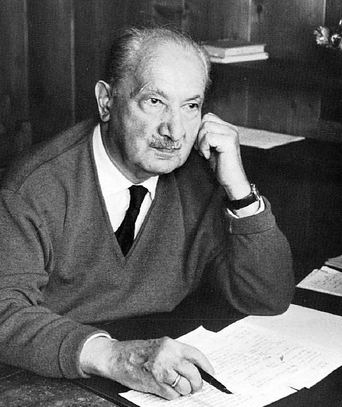
“Insofar as being constitutes what is asked about, and insofar as being means the being of beings, beings themselves turn out to be what is interrogated in the question of being. Beings are, so to speak, interrogated with regard to their being. But, if they are to exhibit the characteristics of their being without falsification they must for their part have become accessible in advance as they are in themselves” |
|
Being and Time
As mentioned at the top, Being and Time was rushed to publication (in 1927) in Heidegger's attempt to acquire a full time teaching position, hence contained only two divisions of his planned first part and none of his planned second part. While he pursued many of these same ideas and themes for his entire life, he never completed the work. For the seventh German edition, Heidegger’s preface announced that the notation of “First Half” was deleted, as he knew he would not complete the second half, for it could not be done, he said, without rewriting the entire work. However, he added, the first part’s “path still remains a necessary one even today if the question of being is to move our Dasein” (Being and Time, xxvii). After the publication of Being and Time, Heidegger's reputation for brilliance, his thought as a brilliant new force, was solidified and renowned widely. Nevertheless, recognition only fueled his personal dissatisfaction with his ideas as presented in Being and Time and his drive to push them further.
As also established above, Being and Time's central topic is "the question of the meaning of being," which is the same as "to question what it means to be," and therefore the work's goal was 'to let that which shows itself be seen from itself in this very way in which it shows itself, that is, this is nothing more than to do Husserl's call: To the Things Themselves!
As a blunter outline of Division One than Heidegger himself offers at the end of the Introduction or start of the first division:
Division 1 is “The Preparatory Fundamental Analysis of Dasein,”
The Care Structure closes Division One, but have we revealed the wholeness of Dasein? Can it lay itself bare in itself as what it is? Or, is it more so that closing division one is an opening up of how all of the preceding revelation of the Being of Dasein as an unified (by Care) manifold (of Being-in-the-world, Being-with, and Being-towards-death) must now be re-examined once more through the perspective of time, hence the work of Division Two ...
Thus, opening Division Two, we see more clearly how the answer is 'no, we have not revealed the wholeness of Dasein,' for Care is the unification of Dasein, but, as care is a concern for possibilities ahead of itself, Dasein is, fundamentally, what it is not-yet. This not-yet shows that there is something Dasein IS that is not. Hence, we need to explore temporality. Namely, Being-towards-Death.
As mentioned at the top, Being and Time was rushed to publication (in 1927) in Heidegger's attempt to acquire a full time teaching position, hence contained only two divisions of his planned first part and none of his planned second part. While he pursued many of these same ideas and themes for his entire life, he never completed the work. For the seventh German edition, Heidegger’s preface announced that the notation of “First Half” was deleted, as he knew he would not complete the second half, for it could not be done, he said, without rewriting the entire work. However, he added, the first part’s “path still remains a necessary one even today if the question of being is to move our Dasein” (Being and Time, xxvii). After the publication of Being and Time, Heidegger's reputation for brilliance, his thought as a brilliant new force, was solidified and renowned widely. Nevertheless, recognition only fueled his personal dissatisfaction with his ideas as presented in Being and Time and his drive to push them further.
As also established above, Being and Time's central topic is "the question of the meaning of being," which is the same as "to question what it means to be," and therefore the work's goal was 'to let that which shows itself be seen from itself in this very way in which it shows itself, that is, this is nothing more than to do Husserl's call: To the Things Themselves!
As a blunter outline of Division One than Heidegger himself offers at the end of the Introduction or start of the first division:
Division 1 is “The Preparatory Fundamental Analysis of Dasein,”
- Hence Chapters 1-6 are Dasein’s analysis: the task seeking to reveal its genuine constitution, which is accomplished by the laying bare of its fundamental structures ...
- i.e., Being of Da-sein is “a structure which is primordially and constantly whole,” but “grants various perspectives on the factors which constitute it” (H.p.41) ... we are seeking to genuinely grasp these constitutive structural factors ...:
- * why? how? ... addressed in ch.1:
- ch.1: preliminary points in analysis of Dasein
- two points as to what it is (existence over essence & always-being-mine/is always its possibility)
- what it is not (Descartes, Dilthey, Bergson, Husserl, Scheler—all get close, but fail to really grasp Dasein, & neither anthropological nor theological conceptions grasp it)
- ch.1: preliminary points in analysis of Dasein
- * we will discover three main factors: being-in-the-world; being-with; and being-towards-death ... the first, most important, most fundamental structural factor: being-in-the-world is addressed in chs.2-3:
- ch.2: Dasein is being-in-the-world
- Dasein is being-in-the-world; this is its facticity; there are many ways of being-in, all reveal Dasein’s being-in-the-world as a ‘dwelling in’ as a ‘taking care of’
- ch.3: phenomenological description/analysis of worldliness of world
- offers more thorough, detailed phenomenological description & analysis of Dasein as being-in-the-world, esp. the differences between Vorhandenheit (objective presence; present-to-hand; ‘theory’) & Zuhandenheit (handiness; ready-to-hand; ‘practice’) (also cf., H.pp.7, 26, 42)
- ch.2: Dasein is being-in-the-world
- * the other two structural factors (being-with & being-towards-death) are addressed in chs. 4-5, their further analysis will reveal the ‘being-in as such’ structure:
- chs.4-5: existential analysis:
- (4:) the they & being-with
- (5:) being-in as such structure (attunement; understanding; discourse; entanglement)
- chs.4-5: existential analysis:
- * the being-in as such structure is then re-analyzed & revealed as the ‘care structure’ as addressed in:
- ch.6: care structure
- this analysis is necessary because we have to remember that the three factors are constitutive parts of a primordial whole ... the wholeness of Dasein is due to Care: care unifies the whole ...
- ch.6: care structure
The Care Structure closes Division One, but have we revealed the wholeness of Dasein? Can it lay itself bare in itself as what it is? Or, is it more so that closing division one is an opening up of how all of the preceding revelation of the Being of Dasein as an unified (by Care) manifold (of Being-in-the-world, Being-with, and Being-towards-death) must now be re-examined once more through the perspective of time, hence the work of Division Two ...
Thus, opening Division Two, we see more clearly how the answer is 'no, we have not revealed the wholeness of Dasein,' for Care is the unification of Dasein, but, as care is a concern for possibilities ahead of itself, Dasein is, fundamentally, what it is not-yet. This not-yet shows that there is something Dasein IS that is not. Hence, we need to explore temporality. Namely, Being-towards-Death.