Saint Augustine
Augustine's influence was immense through the medieval philosophy and theology, continued to deeply impact modern and contemporary thought, as well as having profound influence in many other disciplines. In particular, his Confessions is considered the first and an otherwise exemplar of autobiography. Augustine is a remarkable figure for philosophy as he was the principle lead in the merging of Greek philosophy, predominately Neoplatonism, with Abrahamic religious traditions.
In addition to his Confessions (397-401), Augustine left us an enormous amount of writing—over 100 works, over 200 letters, and nearly 400 sermons—some of his other most notable writings include: Contra Academicos [Against the Academicians, 386-7], De Libero Arbitrio [On the Free Choice of the Will, written over a long period, ca. 387-95], De Magistro [On the Teacher, 389], and De Civitate Dei [On the City of God, 413-27].
In addition to his Confessions (397-401), Augustine left us an enormous amount of writing—over 100 works, over 200 letters, and nearly 400 sermons—some of his other most notable writings include: Contra Academicos [Against the Academicians, 386-7], De Libero Arbitrio [On the Free Choice of the Will, written over a long period, ca. 387-95], De Magistro [On the Teacher, 389], and De Civitate Dei [On the City of God, 413-27].
Contents:
- Augustine's Life
- Augustine's Philosophy
- On Augustine's Confessions
- Textual Analysis of Confessions
- Key Ideas and Questions
1. Augustine's Life
Saint Augustine was born Aurelius Augustinus in Thagaste (a municipality now in Algeria, then under Roman rule) in 354 C.E. to parents Monica (a Christian) and Patricius (a pagan public official), and died in Hippo in August of 430 C.E. (just as Vandals were attacking the gates of the city).
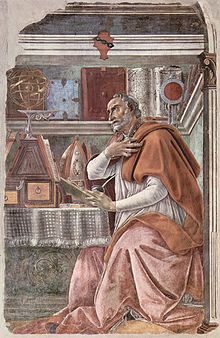 Augustine, by Sandro Botticelli
Childhood: He was born and first studied at Thagaste, a municipality now in Algeria (then under Roman rule), to become public official like his father, Patricius. Monica, his mother, was Christian and provided his mild exposure to Christ, while his father was Pagan. In his infancy, he determined that words are signs of things, we speak so that our will might be obeyed. The adult Augustine begs that the innocent errors of children should be corrected; as example of such an error, he remarks that he preferred God’s creatures to God. We also learn that he preferred grammar to literature.
At about 11 years old, Augustine was sent to Madauras (from about 365-369) to continue his studies (ars gammatica, reading Greek history and myth, Pagan authors), and admits that he loved the Latin classics, especially Virgil, but was quite turned off by the Greeks.
At about 11 years old, Augustine was sent to Madauras (from about 365-369) to continue his studies (ars gammatica, reading Greek history and myth, Pagan authors), and admits that he loved the Latin classics, especially Virgil, but was quite turned off by the Greeks.
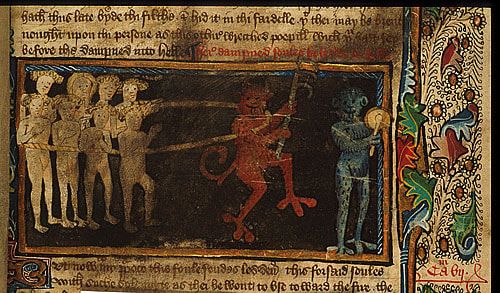
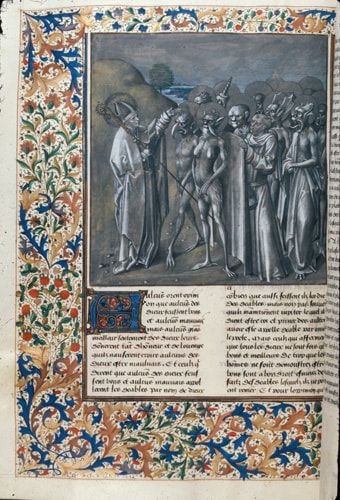 Medieval Illuminated Manuscript showing St. Augustine before the demons.
During a break from school, at about 16 years old, Augustine was back in Thagaste and hand an experience that marked his early life and epitomized his life's spiritual, intellectual, and religious quests: with a gang of his friends, he breaks into a neighbor's garden where they steal pears--the boys had no desire to eat them, only to steal them, or, as he repeats, to sin out of lust. This experience leads Augustine to seek to define sin so to understand why he did it. Definitions he explores include: reflections on how people like what is least good and thereby turn from things of greatest good, God; that people do not sin for the sake of sin, but for some end; and that sinning is a perverse imitation of God. He eventually concludes that sin proves God is the creator; that evil is done by humans' free will; and that the whole avoidance of evil by God’s grace.
As Augustine approaches about 18 years old, ca. 370, we learn that he loved theatrical shows, which lead him to question why people find pleasure in feeling sorrow while watching tragedy. He is now a student of rhetoric at Carthage and most momentously reads Cicero’s Hortensius (only fragments of this work survive) and was greatly moved and inspired by its wisdom. This is his first conversion, in a sense, one to philosophy. Philosophy, for Augustine, was whole pursuit of wisdom, and his obsession with the question of evil was a personal and very visceral question about how to best live one’s life. Sometime around this period he began a 13-year monogamous relationship with a woman who gave him his son, Adeodatus (born 372).
Intellectually and existentially, Augustine deeply questions during this period why Christ is missing in Cicero. He reads the Scriptures, but is unconvinced, finds them simple, too humble. Monica, his mother, dreams he will find his path and she ought to direct him.
In his 20’s Augustine became a Manichaean (remaining one for 9-15 years, depending on accounts), eventually abandoning the belief due to rational inconsistencies), while teaching rhetoric in Thagaste and Carthage, where he had child (Adeodatus, born 372) by his 13-year monogamous mistress. After abandoning Manichaeism, he takes up a teaching position in Rome around 381 (at about 29 years old). It was a risky journey, but he was seeking the ‘better’ students rumored to be there; he is there exposed to the philosophical schools of skepticism, and, his students, while he found them somewhat better, they had the habit of refusing to pay for lessons, and so he leaves Rome. He then moves to Milan, encountering St. Ambrose and Neoplatonism (namely in the vein of Plotinus). He learns four important things from Ambrose: 1) the Scriptures need not be interpreted as literal; 2) that spiritual reality has nothing to do with matter; 3) that evil is nothing, a privation; and 4) that moral evil is from free will, not an evil principle. These lessons move him more towards Christianity--helping him to better understand the problem of evil and how to think God as non-substantial--but, though his mind was ready to convert, his will was not, especially due to his desire for his mistress. Either for this reason, or, because during this time he was encouraged to consider an arranged marriage, he separated from his mistress and son. Soon after, he abruptly resigned his teaching post (ca. 386) and renounced his academic ambitions. Further inspiring encounters follow: he learns about Victorinus’ conversion (an African rhetor converted to Christianity) and then about two court attendants who met ascetics, read St. Anthony, and converted on the spot. Augustine then reads Paul (which aids his complete separation from the mistress and from all sexual relations). In a dramatic scene with his friend in his mother's garden, both desperate for conversion, he hears a child’s voice in a nearby garden calling out "tolle, legge," to pick it up and read it, and interprets it as a command from God. He picks up, opens up the Bible, and his conversion to Christianity happens.
Thereafter, he completely abandons rhetoric, yet spends four months at Cassiciacum writing his earliest works that survive. His son, Adeodatus, dies at age 17. Augustine baptized by Bishop Ambrose on Easter Sunday in 387 at 33 years old. He then moves, in the Confessions, to recall his life and reflect upon the death of his mother Monica at Ostia, outside of Rome. Augustine then returns to Thagaste.
In 391, he was ordained as a priest in Hippo, in North Africa, soon after becoming the Bishop of Hippo. Eventually he was named a Doctor and Saint of the Roman Catholic Church. He died there in Hippo in August of 430 (just as Vandals were attacking the gates of the city).
2) Augustine's Philosophy
There are two key philosophical issues to be explored in Augustine’s work: (1) The interplay of faith and reason and (2) the problem of evil. These will be explored in depth below, but can be summed up here as an introduction:
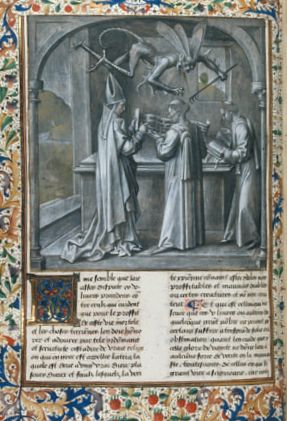 Augustine teaching two clerks as a demon flies overhead
(1) The Interplay of Faith and Reason:
Augustine, like Plato, privileged non-dogmatic reason (our ability to know): The highest truth, for Plato, was a grasp of the form of the Good. Augustine’s interpretation of the Good is either God or the Happy Life.
Consider the Platonic idea of the Good, such is universally and eternally true and, while experience can mislead us (being only mere representations of the form), the employment of reason can permit one to know the Good to some degree. Since Augustine was a strong adherent to Neoplatonism, we would assume that he would privilege the side of Reason over Faith. We receive a strong sense of this necessity for reason when he is defending religious convictions against those who do not believe, for example, as he writes:
However, the problem is more complex and rarely does he rely upon reason alone. In fact, the Confessions reveals his reliance on reason as the greatest hindrance to his full acceptance of faith.
The complexity may be understood by considering his Neoplatonist inheritance. The forms may be universal, knowable truths, but that does not mean we have perfect knowledge of them. Socrates personifies the theory of the forms by explaining our souls have contact with them prior to embodiment and after our bodily deaths; not all souls have full access because one’s access to the forms depends upon the life that one has lived, if one has trained the mind properly to ‘see’ the forms.
So, like how the dialogues’ instructional wisdom rests in their conclusion in aporia, the beauty of the forms is representing the possibility humanity has to know truth though instruction and reflection.
Likewise, in Augustine: In On the Free Choice of the Will, II, he quotes Isaiah, “Unless you believe, you shall not understand” (11). Further, he says,
For Augustine, the foundational premise for the Good, for the Happy Life, is FAITH: “Unless you believe, you shall not understand.” BUT, Reason is that tool which permits understanding of that truth in which we believe. Reason extends and deepens faith. And reason can initiate faith: for the disbeliever may use reason alone to start moving toward God—thus, making reason a preparation for faith.
This interplay of faith and reason is not just an intellectual endeavor for both Plato and Augustine.
The interesting undercurrent to this struggle for understanding, which must be conducted through both reason and faith, is that one struggles against desires by the strength of one’s desire. Augustine describes what happens when LUST dominates the mind:
The first three “storms” caused by the reign of lust are TERROR, DESIRE, and ANXIETY; these storms distract us from “enlightenment,” or understanding the truth, from faith in God. But, as we will see in the Confessions, the REIGN OF LUST produces the same emotional and spiritual ill-ease that is born out of the PURSUIT OF KNOWLEDGE (as understood as living).
Could Augustine attain understanding, attain faith, without knowing the struggles of lust? Does one not need to be able to see the symmetry between desiring good and ill? Socrates claimed that his wisdom was his acknowledgement of his own ignorance; only if one recognizes one’s ignorance can one know what knowledge to look for. The only positive statement he ever made about his wisdom was to claim he knew the art of seduction. This is the same lesson we find in the etymology of “educate” and “seduce” as both born from the Latin root ducere, “to lead.” The abbreviated ex in educere renders its meaning “to lead out” and the se of seducere “to lead away.” Presumably, what one is led out of or away from is ignorance.
This gives us a new insight into this paradox of banishing desires by one’s desire and this struggle most central to one’s life in this world not only suggests the complexity of the interplay between faith and reason, but it also reveals Augustine’s central concern: Augustine was haunted by the Problem of Evil.
Augustine, like Plato, privileged non-dogmatic reason (our ability to know): The highest truth, for Plato, was a grasp of the form of the Good. Augustine’s interpretation of the Good is either God or the Happy Life.
Consider the Platonic idea of the Good, such is universally and eternally true and, while experience can mislead us (being only mere representations of the form), the employment of reason can permit one to know the Good to some degree. Since Augustine was a strong adherent to Neoplatonism, we would assume that he would privilege the side of Reason over Faith. We receive a strong sense of this necessity for reason when he is defending religious convictions against those who do not believe, for example, as he writes:
- I presented my arguments against these men [the Manicheans] … it was impossible to bring up the authority of Sacred Writ in opposition to such perversion … By means of irrefutable argumentation (which I actually accomplished without direct appeal to the truth of any part of the Holy Writ) I showed that God should be praised for all things, and that there are no grounds at all for their belief that there exists two co-eternal natures, one good, one evil … (Augustine, De dono perseverantiae 6).
However, the problem is more complex and rarely does he rely upon reason alone. In fact, the Confessions reveals his reliance on reason as the greatest hindrance to his full acceptance of faith.
The complexity may be understood by considering his Neoplatonist inheritance. The forms may be universal, knowable truths, but that does not mean we have perfect knowledge of them. Socrates personifies the theory of the forms by explaining our souls have contact with them prior to embodiment and after our bodily deaths; not all souls have full access because one’s access to the forms depends upon the life that one has lived, if one has trained the mind properly to ‘see’ the forms.
So, like how the dialogues’ instructional wisdom rests in their conclusion in aporia, the beauty of the forms is representing the possibility humanity has to know truth though instruction and reflection.
Likewise, in Augustine: In On the Free Choice of the Will, II, he quotes Isaiah, “Unless you believe, you shall not understand” (11). Further, he says,
- "… do you think there is anything more excellent than a rational and wise mind? [Evodius answers:] Nothing, I think, except God. [Augustine says:] This is my opinion too. But though we accept this with the strongest faith, understanding it is a very difficult matter" (Augustine, On the Free Choice of the Will, bk. II).
For Augustine, the foundational premise for the Good, for the Happy Life, is FAITH: “Unless you believe, you shall not understand.” BUT, Reason is that tool which permits understanding of that truth in which we believe. Reason extends and deepens faith. And reason can initiate faith: for the disbeliever may use reason alone to start moving toward God—thus, making reason a preparation for faith.
This interplay of faith and reason is not just an intellectual endeavor for both Plato and Augustine.
- For Plato: To use reason to come to know/understand the truth of the FORMS is the utmost struggle one undertakes in life. In his dialogues, Socrates is always presented as the “Gad Fly” (an aimlessly wandering, buzzing, annoying insect), pestering Athens’ citizens; his interlocutors always begin pompously declaring their wisdom concerning X and end having their ignorance put on display before them as they quickly run away from Socrates and further dialogue. Socrates was put on trial and sentenced to death partially for this essential disagreeableness Athens found with his pursuit of wisdom insofar as it involved questioning themselves. At his trial, he says, “the unexamined life is not worth living.” This examination of life is the reflection upon the forms so as to know and know how to pursue the Good Life.
- Likewise For Augustine: Understanding is both difficult—as in the quote above and when he remarks, “… mind can be present in man, and yet not have control” (ibid.)--and an absolutely necessary endeavor. In his On the Free Choice of the Will and in the Confessions we see his profound struggle with coming to know the truth. The texts reveal how easy it is have the mind seduced by the lower faculties of soul and become disordered. There are many unhappy ones who seek those temporal things as opposed to the eternal; who seek those things which can be lost against one’s will and lead one to despair and away from understanding truth. The texts also advise the wise ones to cultivate the four cardinal virtues (prudence, fortitude, temperance, and justice) to avoid evil willing. So Augustine, like Plato, saw the attainment of the Happy/Wise Life as a difficult and necessary struggle.
The interesting undercurrent to this struggle for understanding, which must be conducted through both reason and faith, is that one struggles against desires by the strength of one’s desire. Augustine describes what happens when LUST dominates the mind:
- "… the reign of lust rages tyrannically and distracts the life and whole spirit of man with many conflicting storms of terror, desire, anxiety, empty and false happiness, torture because of the loss of something that he used to love, eagerness to possess what he does not have, grievances for injuries received, and fires of vengeance" (Augustine, On the Free Choice of the Will, Bk.I).
The first three “storms” caused by the reign of lust are TERROR, DESIRE, and ANXIETY; these storms distract us from “enlightenment,” or understanding the truth, from faith in God. But, as we will see in the Confessions, the REIGN OF LUST produces the same emotional and spiritual ill-ease that is born out of the PURSUIT OF KNOWLEDGE (as understood as living).
Could Augustine attain understanding, attain faith, without knowing the struggles of lust? Does one not need to be able to see the symmetry between desiring good and ill? Socrates claimed that his wisdom was his acknowledgement of his own ignorance; only if one recognizes one’s ignorance can one know what knowledge to look for. The only positive statement he ever made about his wisdom was to claim he knew the art of seduction. This is the same lesson we find in the etymology of “educate” and “seduce” as both born from the Latin root ducere, “to lead.” The abbreviated ex in educere renders its meaning “to lead out” and the se of seducere “to lead away.” Presumably, what one is led out of or away from is ignorance.
This gives us a new insight into this paradox of banishing desires by one’s desire and this struggle most central to one’s life in this world not only suggests the complexity of the interplay between faith and reason, but it also reveals Augustine’s central concern: Augustine was haunted by the Problem of Evil.

|
|
|
(2) The Classic Problem of Evil:
The problem arises from the conflicts that come from three of God’s most essential attributes:
Specifically, the conflict comes from the questions that thus follow: If God is all-good, and evil exists, and he neither is nor does evil, how can he know evil? If God is all-good, and evil exists, and he neither is nor does evil, then how can he be all-powerful?
Further, God’s omnipotence determines him to be the creator of everything. However, God is also absolutely good; so, if he created everything, than he must have created evil, but if he is all-good, then he cannot have created evil. Therefore, since there is evil in the world, either God did not create it, thus not all-powerful, or he did create evil and he is thus not all good.
Thus, how can evil have come to be and still exist in the world without diminishing God?
This problem drives Augustine’s long and torturous path to religious conversion ... hence, it is sensible to now turn to Confessions:
The problem arises from the conflicts that come from three of God’s most essential attributes:
- God is omniscient (sees/knows all),
- omnipotent (all-powerful), and
- omnibenevolent (all-good).
Specifically, the conflict comes from the questions that thus follow: If God is all-good, and evil exists, and he neither is nor does evil, how can he know evil? If God is all-good, and evil exists, and he neither is nor does evil, then how can he be all-powerful?
Further, God’s omnipotence determines him to be the creator of everything. However, God is also absolutely good; so, if he created everything, than he must have created evil, but if he is all-good, then he cannot have created evil. Therefore, since there is evil in the world, either God did not create it, thus not all-powerful, or he did create evil and he is thus not all good.
Thus, how can evil have come to be and still exist in the world without diminishing God?
This problem drives Augustine’s long and torturous path to religious conversion ... hence, it is sensible to now turn to Confessions:
3) On Augustine's Confessions
The Confessions is Augustine's autobiographical exploration of his anxiety-ridden religious conversion to Christianity written in thirteen books, or chapters, where the first nine span his memories of his past from infancy to about age 33, book ten is an examination of memory, and books eleven to thirteen discuss his philosophy of time, eternity, and an exegesis on the opening book of Genesis.
- Bks. I-IX: Present time of things past: Memory of Past:
- Conversion journey from infancy to 33
- Bk. X: Present time of things present: Intuition of Present:
- Current difficulties as recalling past events and discussion of memory
- Bks. XI-XIII: Present time of things future: Expectation of Future:
- Exegesis on Genesis and on time and eternity
This layout strikes some as strange if the work is considered only an autobiography about a Saint’s search for happiness (conceived as a state of ease and lack of anxiety) and truth that lead to his religious conversion. Book X, however, reveals a way for us to consider the form of his text as a demonstration of his philosophy of memory and time. Remembering that the theme “a quest to know God” in many ways epitomizes medieval philosophy, Augustine's Confessions can easily be seen as its preeminent examination, as the work that thoroughly delineates and embodies the knowing, the act of seeking this knowledge.
The Confessions begins: “How can I seek you God if I do not remember you?”—it thus begins as a present memory of his past (infancy) in which he tries to remember in his life that which he had forgotten—God.
In the mystical tradition, Augustine will reveal that the self is essentially a relation to God: the more we delve into the self, the closer we come to God. Thus, his reflection upon his life is movement towards God. Autobiography is a form necessarily situated within time through memory, whose material is one’s ontic existence.
“Oh, in the name of all your mercies, O Lord my God, tell me what you are to me!
Say into my soul: I am thy salvation. Speak so that I can hear.
See, Lord, the ears of my heart are in front of you. Do not hide your face from me.
Let me die, lest I should die indeed; only let me see your face.”
—Saint Augustine, Confessions, Bk. I, Ch.5.
4) Textual Analysis of Augustine's Confessions
Book I: Infancy and childhood
Chapters 1 - 5:
The Confessions begins: “How can I seek you God if I do not remember you?” Incessant questions—it thus begins as a present memory of his past (infancy) in which he tries to remember in his life that which he had forgotten—God.
The incessant questions: Note how these focus upon the quest to know God. They invoke the dilemma of the interplay of faith and reason:
They also beseech God for His permission to seek Him by seeking knowledge:
Chapters two and three invoke the Neoplatonist emanation theory –recall this from our discussions of Boethius--it is the idea of creation being a procession or a pouring forth or overflowing of/from God of all things into creation and is then followed cyclically with a desire in all things to return back (reversion) to one’s source. The text reveals this through the questioning of how all is from God, and thus in Him, and how He is in all things, as creator (i.e., all in God and God in all things—note, however, that this avoids pantheism because God is also transcendent of all things). The text also reveals this theory in its language and imagery in chapter three: “filled them,” “pour that surplus of yourself,” “contain all things and it is by containing things that you fill them,” “vessels,” “poured out over us,” “scattered … brought together,” “fill everything,” etc. The most common image of emanation is the cycle of water, pouring down and evaporating back up to the source.
These chapters also invoke the Neoplatonist inheritance of mereology –again, recall Boethius discussions—mereology is the study of parts and wholes, which we see through the questioning of the one and the many. We see this in the text through questions of God being wholly present in all things or partially in all things, and if all things are in Him wholly or partially: “Or can we say that, because all things together are unable to contain you wholly, therefore each thing contains only a part of you? Does everything contain the same part? Or are there different parts …” (I, 3).
Chapter four then asks “what” is God, and reveals an intense delineation of His attributes. Note that this follows logically from discussions of mereology because there will be debate if the attributes are parts of God, or if these parts can also be considered His whole, even if inadequate to encompass all that He is. These questions are crucial because these different attributes can clearly contradict or limit one another; thus, understanding how they are what God is is crucial to understanding God, and thus being able to pay homage to him through faith. Also notice in this delineation of attributes that Augustine does not permit God any of the lacks of attributes, for example, “You love, but with no storm of passion; you are jealous, but with no anxious fear …” (I, 4). Thus, He has everything in Him, since everything is of/from Him, yet not in a corrupt way or as a privation.
Notice herein, too, the consideration of “speaking.” He asks, “What does any man succeed in saying when he attempts to speak of you? Yet woe to those who do not speak of you at all, when those who speak most say nothing” (I, 4). These questions are also critical to his work, since it is his “confession.” He is speaking/writing himself to God. To confess, confessus, comes from the Latin past participle of confiteri, to acknowledge, and can be understood as a pubic pronouncement of faith or an admission of guilt where the latter can be religious or civil. [Confiteri is from com-, together, and fatus, the past participle of fateri, to admit (fari, to say or to speak), thus we see the connection between speaking and confessing.] But, we can see this text is about much more than a mere delineation of his wrongs.
Book II, Ch. 3 has a further comment about why and to whom he is writing: “But to whom am I relating this? Not to you, my God. But I am telling these things un your presence to my own kind …. And my object in doing so is simply this: that both I myself and whoever reads what I have written may think out of what depths we are to cry unto Thee. For nothing comes nearer to your ears than a confessing heart and a life of faith” (II, 3). (X, 2 has further passages on the question of to whom and why.)
So, the Confessions is addressed dually: to God and to witnesses. But, why confess to an omniscient God? He knows without you giving testimony, for you are testimony in your being insofar as He is your creator. One is one’s confession: “testimony” is from the Latin testimonium, evidence or proof, where testis is witness and monium signifies an action, condition, or state of being (the term is implicitly religious, it initially designated the Ten Commandments).
It is further peculiar that Augustine is confessing because his Confessions reveals him as a seeker readily pronouncing ignorance:
Finally, note how chapter five takes on a very desperate tone, almost a bit presumptuous: “Oh, that you would come into my heart and so inebriate it that I would forget my own evils …” (I, 5); “What are you to me? Have mercy on me that I may speak. What am I to you that you should demand to be loved by me?” (I, 5); “Oh, in the name of all your mercies, O Lord my God, tell me what you are to me! Say into my soul: I am thy salvation. Speak so that I can hear. See, Lord, the ears of my heart are in front of you. Do not hide your face from me. Let me die, lest I should die indeed; only let me see your face” (I, 5); and “It is in a state of collapse; will you not rebuild it?” (I, 5). Here, we sense that Augustine, in his love for God, is being a rather tempestuous lover, and rather demanding.
Chapters 6 –7:
Infancy. Innocent errors of children should be corrected. His mistake was that he paid attention to God’s creatures and not to God.
Chapter six gives us a wonderful genealogy of knowledge: he came into the world (via mother and via God) knowing only “… how to suck, to be content with bodily pleasure, and to be discontented with bodily pain; that was all” (I, 6). Then, began to smile, then to become conscious, then desired to express himself, which he did through his “limited forms of communication,” since his whole desire hinged upon making his “feelings intelligible to others” (I, 6). (This genealogy continues in chapter eight.)
Chapters 8-16:
Schooling. Not like lessons. Not like Greek, liked Latin. He approves of grammar more than of literature (Homer) where immoral people are given divine attributes and this hides their vice. (ch.9, knots of language). (ch. 11 baptism).
Chapter eight continues the genealogy of knowledge by relating how he learned to speak. This chapter was quite influential on developmental models and the philosophy of language, and perhaps most famous as its citation and sharpest critique by Wittgenstein in the beginning of his Philosophical Investigations (also critiqued in de Saussure’s theory of the arbitrariness of the sign). Essentially, Augustine argues that he learned language through his own use of reason (given him by God), but having the pre-existing inner feelings that he desired to express in an intelligible manner; thus, he observed how adults communicated and slowly learned that the words they said corresponded to things in the world; he then practiced making these sounds, and was, finally, then able to speak.
These chapters also lay out, at length, the varieties of his sins, thus, most closely representing a true confession.
Chapter 11 reveals that his mother had “marked [him] with the sign of the Lord’s cross” when he was born and he goes on to wonder about youth or adult baptism, questioning why baptism should be delayed, and if this does not just offer one free rein within which to sin before commitment to God.
We also learn a lot about his love of Latin literature and his dislike for Greek and other studies. His criticism against school teachers and the literati is intense; it is also curious that he so dismisses rhetoric (which he gave up before his conversion), yet his work is beautifully written and relies on a number of persuasive tactics (see below).
Chapters 16 –20:
Language, Words. Words are signs of things and we are prompted to learn how to speak so that our will will be obeyed. Doing good involves doing it willingly and not accidentally.
These remaining chapters have the clearest condemnation of the persuasive power of words, as he expresses it, speaking hyperbolically for schools, “This is where you can learn words. This is where you can learn that art of eloquence which is so essential for gaining your own ends and for expressing your own opinions” (I, 16). Again, I wonder why the intensity—he was a rhetor early, and while he gave it up before his conversion, he was made priest and then bishop, he gave many, many sermons, and he wrote this text, clearly saying it is both for God and for other witnesses who may read it and benefit from it. The Confessions is a persuasive and artfully crafted work. Do we wonder, then, if his dismissal should be read a little like Socrates’, who proclaimed, in the Apology, that the lie he was most offended at was that Meletus, et al, accused him of being a crafty or clever speaker, and that he was not, but would speak in his everyday style …? Is there an irony, then, for dismissing the persuasive power of speech? And, does this also, perhaps, reflect upon that interplay of faith and reason? On which side would we put persuasion? (Recall, also, a similar discussion we had with Boethius about the dismissal of the muses of poetry by the muse of Philosophy—who still used poetry!)
Chapters 1 - 5:
The Confessions begins: “How can I seek you God if I do not remember you?” Incessant questions—it thus begins as a present memory of his past (infancy) in which he tries to remember in his life that which he had forgotten—God.
The incessant questions: Note how these focus upon the quest to know God. They invoke the dilemma of the interplay of faith and reason:
- “For how can one pray to you unless one knows you? If one does not know your, one may pray not to you, but to something else. Or is it rather the case that we should pray to you in order that we may come to know you?” (I, 1).
- “And how shall I pray to my God …” (I, 2) and “How can I call you when I am already in you” (Ibid.).
- “What, then, is my God?” (I, 4).
- —which unleashes a delineation of His attributes (e.g., highest, best, all-powerful, merciful, just, etc.).
They also beseech God for His permission to seek Him by seeking knowledge:
- “Let me seek you, Lord, by praying to you and let me pray believing in you; since to us you have been preached” (I, 1)—which suggests seeking by demonstration of faith, but the seeking is done in knowing.
Chapters two and three invoke the Neoplatonist emanation theory –recall this from our discussions of Boethius--it is the idea of creation being a procession or a pouring forth or overflowing of/from God of all things into creation and is then followed cyclically with a desire in all things to return back (reversion) to one’s source. The text reveals this through the questioning of how all is from God, and thus in Him, and how He is in all things, as creator (i.e., all in God and God in all things—note, however, that this avoids pantheism because God is also transcendent of all things). The text also reveals this theory in its language and imagery in chapter three: “filled them,” “pour that surplus of yourself,” “contain all things and it is by containing things that you fill them,” “vessels,” “poured out over us,” “scattered … brought together,” “fill everything,” etc. The most common image of emanation is the cycle of water, pouring down and evaporating back up to the source.
These chapters also invoke the Neoplatonist inheritance of mereology –again, recall Boethius discussions—mereology is the study of parts and wholes, which we see through the questioning of the one and the many. We see this in the text through questions of God being wholly present in all things or partially in all things, and if all things are in Him wholly or partially: “Or can we say that, because all things together are unable to contain you wholly, therefore each thing contains only a part of you? Does everything contain the same part? Or are there different parts …” (I, 3).
Chapter four then asks “what” is God, and reveals an intense delineation of His attributes. Note that this follows logically from discussions of mereology because there will be debate if the attributes are parts of God, or if these parts can also be considered His whole, even if inadequate to encompass all that He is. These questions are crucial because these different attributes can clearly contradict or limit one another; thus, understanding how they are what God is is crucial to understanding God, and thus being able to pay homage to him through faith. Also notice in this delineation of attributes that Augustine does not permit God any of the lacks of attributes, for example, “You love, but with no storm of passion; you are jealous, but with no anxious fear …” (I, 4). Thus, He has everything in Him, since everything is of/from Him, yet not in a corrupt way or as a privation.
Notice herein, too, the consideration of “speaking.” He asks, “What does any man succeed in saying when he attempts to speak of you? Yet woe to those who do not speak of you at all, when those who speak most say nothing” (I, 4). These questions are also critical to his work, since it is his “confession.” He is speaking/writing himself to God. To confess, confessus, comes from the Latin past participle of confiteri, to acknowledge, and can be understood as a pubic pronouncement of faith or an admission of guilt where the latter can be religious or civil. [Confiteri is from com-, together, and fatus, the past participle of fateri, to admit (fari, to say or to speak), thus we see the connection between speaking and confessing.] But, we can see this text is about much more than a mere delineation of his wrongs.
Book II, Ch. 3 has a further comment about why and to whom he is writing: “But to whom am I relating this? Not to you, my God. But I am telling these things un your presence to my own kind …. And my object in doing so is simply this: that both I myself and whoever reads what I have written may think out of what depths we are to cry unto Thee. For nothing comes nearer to your ears than a confessing heart and a life of faith” (II, 3). (X, 2 has further passages on the question of to whom and why.)
So, the Confessions is addressed dually: to God and to witnesses. But, why confess to an omniscient God? He knows without you giving testimony, for you are testimony in your being insofar as He is your creator. One is one’s confession: “testimony” is from the Latin testimonium, evidence or proof, where testis is witness and monium signifies an action, condition, or state of being (the term is implicitly religious, it initially designated the Ten Commandments).
It is further peculiar that Augustine is confessing because his Confessions reveals him as a seeker readily pronouncing ignorance:
- “Let me know you, my known, let me know Thee even as I am known” (X, 1),
- and “how shall I find you if I do not remember you” (X, 17),
- and “how can one pray to you unless one knows you” (I, 1)?
Finally, note how chapter five takes on a very desperate tone, almost a bit presumptuous: “Oh, that you would come into my heart and so inebriate it that I would forget my own evils …” (I, 5); “What are you to me? Have mercy on me that I may speak. What am I to you that you should demand to be loved by me?” (I, 5); “Oh, in the name of all your mercies, O Lord my God, tell me what you are to me! Say into my soul: I am thy salvation. Speak so that I can hear. See, Lord, the ears of my heart are in front of you. Do not hide your face from me. Let me die, lest I should die indeed; only let me see your face” (I, 5); and “It is in a state of collapse; will you not rebuild it?” (I, 5). Here, we sense that Augustine, in his love for God, is being a rather tempestuous lover, and rather demanding.
Chapters 6 –7:
Infancy. Innocent errors of children should be corrected. His mistake was that he paid attention to God’s creatures and not to God.
Chapter six gives us a wonderful genealogy of knowledge: he came into the world (via mother and via God) knowing only “… how to suck, to be content with bodily pleasure, and to be discontented with bodily pain; that was all” (I, 6). Then, began to smile, then to become conscious, then desired to express himself, which he did through his “limited forms of communication,” since his whole desire hinged upon making his “feelings intelligible to others” (I, 6). (This genealogy continues in chapter eight.)
Chapters 8-16:
Schooling. Not like lessons. Not like Greek, liked Latin. He approves of grammar more than of literature (Homer) where immoral people are given divine attributes and this hides their vice. (ch.9, knots of language). (ch. 11 baptism).
Chapter eight continues the genealogy of knowledge by relating how he learned to speak. This chapter was quite influential on developmental models and the philosophy of language, and perhaps most famous as its citation and sharpest critique by Wittgenstein in the beginning of his Philosophical Investigations (also critiqued in de Saussure’s theory of the arbitrariness of the sign). Essentially, Augustine argues that he learned language through his own use of reason (given him by God), but having the pre-existing inner feelings that he desired to express in an intelligible manner; thus, he observed how adults communicated and slowly learned that the words they said corresponded to things in the world; he then practiced making these sounds, and was, finally, then able to speak.
These chapters also lay out, at length, the varieties of his sins, thus, most closely representing a true confession.
Chapter 11 reveals that his mother had “marked [him] with the sign of the Lord’s cross” when he was born and he goes on to wonder about youth or adult baptism, questioning why baptism should be delayed, and if this does not just offer one free rein within which to sin before commitment to God.
We also learn a lot about his love of Latin literature and his dislike for Greek and other studies. His criticism against school teachers and the literati is intense; it is also curious that he so dismisses rhetoric (which he gave up before his conversion), yet his work is beautifully written and relies on a number of persuasive tactics (see below).
Chapters 16 –20:
Language, Words. Words are signs of things and we are prompted to learn how to speak so that our will will be obeyed. Doing good involves doing it willingly and not accidentally.
These remaining chapters have the clearest condemnation of the persuasive power of words, as he expresses it, speaking hyperbolically for schools, “This is where you can learn words. This is where you can learn that art of eloquence which is so essential for gaining your own ends and for expressing your own opinions” (I, 16). Again, I wonder why the intensity—he was a rhetor early, and while he gave it up before his conversion, he was made priest and then bishop, he gave many, many sermons, and he wrote this text, clearly saying it is both for God and for other witnesses who may read it and benefit from it. The Confessions is a persuasive and artfully crafted work. Do we wonder, then, if his dismissal should be read a little like Socrates’, who proclaimed, in the Apology, that the lie he was most offended at was that Meletus, et al, accused him of being a crafty or clever speaker, and that he was not, but would speak in his everyday style …? Is there an irony, then, for dismissing the persuasive power of speech? And, does this also, perhaps, reflect upon that interplay of faith and reason? On which side would we put persuasion? (Recall, also, a similar discussion we had with Boethius about the dismissal of the muses of poetry by the muse of Philosophy—who still used poetry!)
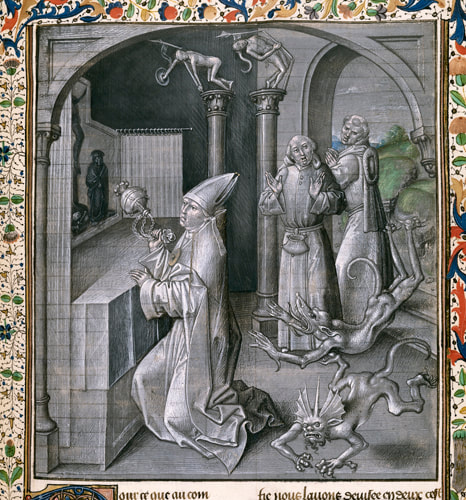
Augustine prays at the alter, and devils and demons fall
Confessions, Book II, age 16
Overview Bk. II: Age 16 in Thagaste with ‘debased’ boys—stole pears and fed them to pigs. Committed theft out of no need or enjoyment of the things themselves (pears not attractive in appearance or taste).
Chapter 1 - 3:
He begins by saying that he wants to recall his “past impurities,” not because he is proud of them, but to confess them out of his love of God (1). His past impurities consisted in loving and being loved in the sense of the “muddy cravings of the flesh;” his lust is awakened, and beneath the flowered prose, we can assume that he discovered the fairer sex through fornication (some may well argue that is was not really pears that the young boys stole) (2-3). Augustine is back in his hometown of Thagaste (from Madaura and before going to Carthage) and befriends a group of ‘debased’ boys (3). He confesses that he sought their approval and love instead of God’s. He bemoans his family for not having married him off to keep him from such lust (2) and demands why did God remain silent while his lust took him further and further from God (3)? Although, he does admit that now he sees his mother’s warnings to have been the command of God coming through his mother (3).
Chapter 4-10:
The pear tree was in a neighbor’s yard, and their theft was a forbidden act. The young boys stole the fruits, not to eat, but just to steal them, ultimately feeding them to some pigs. They committed the theft out of no need or enjoyment of the things themselves, as the pears were not attractive in appearance or taste, which leads the ashamed, adult Augustine to struggle to come to a definition of sin, so as to be able to explain why he sinned.
In Book II, Augustine raises at least seven possible reasons for why he sinned:
“and yet I still could not understand clearly and distinctly what was the cause of evil” (VII.3)
“But I still asked: ‘What is the origin of evil?” (VII.7):
For Comparison, Consider EVIL for Socrates and Aristotle:
Overview Bk. II: Age 16 in Thagaste with ‘debased’ boys—stole pears and fed them to pigs. Committed theft out of no need or enjoyment of the things themselves (pears not attractive in appearance or taste).
Chapter 1 - 3:
He begins by saying that he wants to recall his “past impurities,” not because he is proud of them, but to confess them out of his love of God (1). His past impurities consisted in loving and being loved in the sense of the “muddy cravings of the flesh;” his lust is awakened, and beneath the flowered prose, we can assume that he discovered the fairer sex through fornication (some may well argue that is was not really pears that the young boys stole) (2-3). Augustine is back in his hometown of Thagaste (from Madaura and before going to Carthage) and befriends a group of ‘debased’ boys (3). He confesses that he sought their approval and love instead of God’s. He bemoans his family for not having married him off to keep him from such lust (2) and demands why did God remain silent while his lust took him further and further from God (3)? Although, he does admit that now he sees his mother’s warnings to have been the command of God coming through his mother (3).
Chapter 4-10:
The pear tree was in a neighbor’s yard, and their theft was a forbidden act. The young boys stole the fruits, not to eat, but just to steal them, ultimately feeding them to some pigs. They committed the theft out of no need or enjoyment of the things themselves, as the pears were not attractive in appearance or taste, which leads the ashamed, adult Augustine to struggle to come to a definition of sin, so as to be able to explain why he sinned.
In Book II, Augustine raises at least seven possible reasons for why he sinned:
- 1) Out of need or enjoyment of the things themselves (“I had no wish to enjoy what I tried to get by theft” (II.4); “all I tasted in them was my own iniquity” (II.6).).
- 2) Due to a lack or despise of a proper feeling or presence of an improper feeling (“I lacked and despised proper feeling and was stuffed with iniquity” (II.4); “all I tasted in them was my own iniquity” (II.6).)
- 3) Sin to enjoy the act of sin (no reason for it: “The evil was foul, and I loved it; I loved destroying myself; I loved my sin …” (II.4); “I only took these ones in order that I might be a thief” (II.6); “loved crime for crime’s sake” (II.7); “love nothing except the theft itself” (II.8). The hardest to fathom (re: II.5, 6).)
- 4) Sin to attain an end (a lower good) or avoid losing something (immoderate liking for material things—“desire for gaining or a fear of losing some of these goods we have described as ‘lower’” (II.5)—as a turning away from eternal things; “Yet for all these things … sin is committed. For there are goods of the lowest order, & we sin if, while following them with too great an affection, we neglect those goods which are better & higher …” (II.5).)
- 5) Sin to imitate acts found only in God (seek to imitate God’s omnipotence: “did I imitate my Lord?… producing a darkened image of omnipotence?” (II.6)—thereby perverting it; e.g., pride imitates loftiness of mind, ambition seeks honor, wanton sexuality imitates love, curiosity imitates desire for knowledge.)
- 6) Sin to enjoy the crime and association (if he was alone he would not have done it: “friendship, knotted in affection, is a sweet thing …” (II.5); “a pleasure occasioned by the company of others who were sinning with me” (II.8); “nor would I have got any pleasure out of it by myself, nor would I have done it by myself” (II.9)).
- 7) Cannot be known; doesn’t truly understand his own sins (“Who can disentangle this most twisted and most inextricable knottiness?” (II.10)). (Is this proposing a Platonic account of evil caused by ignorance? Augustine seems to favor an Aristotelian akrasia—one can know X is evil, but still desire to and do it.)
“and yet I still could not understand clearly and distinctly what was the cause of evil” (VII.3)
“But I still asked: ‘What is the origin of evil?” (VII.7):
- “free will is the cause of our doing evil and your just judgment the cause of our suffering it” (VII.3).
- --“act of willing was mine … here was the cause of my sin” (VII.3)
- --but, “things which I did unwillingly … I was suffering rather than doing … such things to be my punishment … you as just…I was not being punished unjustly. But then I asked: ‘Who made me? Was it not my God,…goodness itself? How then could it be that I should will evil and refuse my assent to good, so that it would be just for me to be punished?” (VII.3).
- “If the devil is responsible, then where did the devil come from?” (VII.3).
- “the incorruptible was better than the corruptible” (VII.4).
- “I searched for the origin of evil and I searched for it in an evil way … I put the whole creation in front of the eyes of my spirit …” (VII.5).
- --“Where, then, is evil? Where did it come from and how did it creep in here? What is its root and seed? Or does it simply not exist?” (VII.5).
- –“where:” substances occupy space; “creep:” “[heathens]shall lick dust as a serpent; as creeping things of earth they shall be disturbed, or troubled, [out] of their houses; they shall not desire our Lord God” (Micah 7:17); “root and seed:” dormant potential, perhaps unforeseen—“was there some evil element in the material of creation, & did God shape & form it, yet still leave in it something … He did not change into good?” (VII5).
- --“Where, then, is evil? Where did it come from and how did it creep in here? What is its root and seed? Or does it simply not exist?” (VII.5).
- God: “I am that I am” vs. “other things … neither are nor are not in existence” (VII.10-11).
- --“things which are subject to corruption are good. They would not be subject to corruption if they were either supremely good or not good at all: for, if they were supremely good, they would be incorruptible, and, if there was nothing good in them, there would be nothing which could be corrupted” (VII.12).
- --“all things which suffer corruption are deprived of something good in them” (VII.12).
- --“Therefore, so long as they exist, they are good. Therefore all things that are, are good, and as to that evil … it is not a substance, since if it were a substance, it would be good” (VII.12).
- “To you then, there is no such thing at all as evil. And the same is true … [for] your whole creation” (VII.13).
- –“But in some of its parts there are some things which are considered evil because they do not harmonize with other parts; yet with still other parts they do harmonize and are good and they are good in themselves. And all these things which do not fit in with each other do fit in with that lower part of creation which we call the earth” (VII.13: God’s eye view)
- “‘What is wickedness?’ … it is not a substance but a perversity of the will turning away from you, God … toward lower things—casting away, as it were, its own insides and swelling with desire for what is outside it” (VII.16).
- –Genealogy of knowledge/Ladder of judgments (VII.17) describes making correct judgments re: evil, but also model for ordering the self and, hence, to keep from evil.
For Comparison, Consider EVIL for Socrates and Aristotle:
- Evil for Socrates:
- Socrates proposes that Virtue is Knowledge; for him to be able to hold this position, one has to understand the nature of virtue’s opposite: vice is ignorance.
- By our being essentially knowing beings, our natures, then, are naturally virtuous. Naturally virtuous, we do not naturally desire evil. And, if virtue is knowledge, than evil, its opposite, cannot be knowledge, it must be ignorance. So, if it is not known, one cannot knowingly choose it. In other words, beneath the claim that virtue is knowledge are two premises:
- (1) No one desires evil — what we want is the good, if we do desire evil, it is b/c we think it is good.
- (2) No one deliberately does evil — they are just ignorant of what the good really is.
- Evil for Aristotle:
- Aristotle rejects Plato’s idea that we can never knowingly desire evil. This becomes apparent in his explanation of Akrasia (incontinence, or the lack of virtue) in his Nicomachean Ethics, in which all character virtues are the means between two extremes, for example, the virtue of courage is that which is neither cowardice nor foolhardiness. These extremes are vices. However, he has a category of wrong that is not vice, but neither is it virtue: Akrasia. This is the conflict born from the desire for pleasure that has the power to overcome our reasoning about the right choice. So, this lack of virtue that is not wholly vice is a passionate power that overwhelms the mind and makes us do evil even when we know it is not the good.
- So, Akrasia, incontinence, is the weakness of will. This is not ignorance of the good; rather, it is ignoring the good: I may know that eating fifteen cherry pies is the vice of overindulgence, and that it is better to only eat one slice, yet, I choose to eat all fifteen pies anyway.
- Is either of these models closest to why Augustine may have sinned?
- - - The Intervening Books: III to VI - - -
Book III: Later Youth
Augustine becomes skilled at rhetoric, generating a great vanity in the young man. He was notably influenced by Cicero’s Hortensius, which sparked his interest in philosophy and may be considered his first “conversion,” and intellectual one.
This conversion inspires his desire of wisdom over the pleasures of the senses. He was impressed by the content and rhetoric of the Hortensius but something…he later identifies as the name of Christ--was missing. Scripture seemed unworthy to him so he turned to Manichaeism: this is his second “conversion:”
The adult Augustine decides that the Manicheans spoke of Christ and Holy Spirit but it was not in their hearts; they searched for God through the senses instead of intellectual understanding.
Book IV: Augustine as a Manichean (from 19 to 28).
He taught rhetoric for lawyers and had a child. Reads Aristotle’s Categories and he included God under the categories. He tries to understand God as a body.
Book V: Rome and Milan (age 29 and up).
The attempt to find oneself can help one to find God.
Begins to doubt Astronomy/Astrology; they may speak truthfully about creatures, but not about God. Yet, astronomical truths established mathematically contradicted some of Mani’s teachings and force Mani to declare natural science sacrilegious in the face of disagreement. This begins to spark doubt in Manichaeism; this is further ignited when Faustus, said to be a very wise Manichee, was unable to answer any of his questions about its relation to natural science. A further point of doubt was about the lack of ethical responsibility born from their theory of sin, which was due to some different nature within us.
Augustine leaves Cartage and goes to Rome.
At this point he comes across the Skeptics of the Academy and they seem to him to be the wisest of all.
Meets St. Ambrose; was impressed by his content on God, but not his style. Ambrose instructed him to interpret the Bible metaphorically, that evil as a privation and not a substance, and that there is free will (deliberately doing evil). While he saw that the Catholic faith could be defended against Manicheanism, and this is enough to make him leave the Manichean position, he is not ready to convert to Christianity. It takes Augustine many more books before he is able to understand and accept these lessons.
Book VI: Years of Struggle.
Book III: Later Youth
Augustine becomes skilled at rhetoric, generating a great vanity in the young man. He was notably influenced by Cicero’s Hortensius, which sparked his interest in philosophy and may be considered his first “conversion,” and intellectual one.
This conversion inspires his desire of wisdom over the pleasures of the senses. He was impressed by the content and rhetoric of the Hortensius but something…he later identifies as the name of Christ--was missing. Scripture seemed unworthy to him so he turned to Manichaeism: this is his second “conversion:”
- Manichaeism:
- was a dominating and wide-spread, organized religion between, approximately, the 3rd and 16th centuries. It was founded by the Babylonian prophet Mani (ca. 210-276 ce, within the Persian empire), who composed arguably six to eight sacred texts, of which only fragments survive, said to be the complete teachings only partially revealed by the Buddha, Jesus, and Zoroaster (who promoted a similar dualism between truth and lie, albeit not a cosmological explanation, and whose priesthood was said to have put Mani to death ca. 276). The main character of the religion was its dualism; his central tenet posited two contrasting forces, light and dark, which roughly correspond to good and evil, peace and violence, and spirit and matter. All things are a combination of these elements, so there is no fully omnipotent God. Humanity, as the preeminent combination of the corruptible and incorruptible (body and soul), is the central ground where these forces do battle and can overcome the darkness by complete union with the incorruptible aspect.
The adult Augustine decides that the Manicheans spoke of Christ and Holy Spirit but it was not in their hearts; they searched for God through the senses instead of intellectual understanding.
Book IV: Augustine as a Manichean (from 19 to 28).
He taught rhetoric for lawyers and had a child. Reads Aristotle’s Categories and he included God under the categories. He tries to understand God as a body.
Book V: Rome and Milan (age 29 and up).
The attempt to find oneself can help one to find God.
Begins to doubt Astronomy/Astrology; they may speak truthfully about creatures, but not about God. Yet, astronomical truths established mathematically contradicted some of Mani’s teachings and force Mani to declare natural science sacrilegious in the face of disagreement. This begins to spark doubt in Manichaeism; this is further ignited when Faustus, said to be a very wise Manichee, was unable to answer any of his questions about its relation to natural science. A further point of doubt was about the lack of ethical responsibility born from their theory of sin, which was due to some different nature within us.
Augustine leaves Cartage and goes to Rome.
At this point he comes across the Skeptics of the Academy and they seem to him to be the wisest of all.
Meets St. Ambrose; was impressed by his content on God, but not his style. Ambrose instructed him to interpret the Bible metaphorically, that evil as a privation and not a substance, and that there is free will (deliberately doing evil). While he saw that the Catholic faith could be defended against Manicheanism, and this is enough to make him leave the Manichean position, he is not ready to convert to Christianity. It takes Augustine many more books before he is able to understand and accept these lessons.
Book VI: Years of Struggle.
 Lions, from a medieval bestiary
Augustine’s inability to understand how God as spirit could not be corporeal if man was made in his image converts him to skepticism. He wants to be certain of invisible and immaterial things as he was certain of mathematics. The adult Augustine explains that faith is necessary for reason and knowledge, and that he did not yet have any.
He wants joy in truth. He still clings to worldly honors. Thinks about monastic life. His wife leaves and leaves his son with him, he gets another woman. He abandons carnal pleasures due to fear of God’s judgment. He opposes Epicurean hedonism which makes sense only if there is no afterlife and judgment.
He wants joy in truth. He still clings to worldly honors. Thinks about monastic life. His wife leaves and leaves his son with him, he gets another woman. He abandons carnal pleasures due to fear of God’s judgment. He opposes Epicurean hedonism which makes sense only if there is no afterlife and judgment.
Book VII: Growing to Manhood: Preamble to his Conversion. --Incorporeality & Evil--
Chapter 1:
Growing into manhood, the problem that plagued Augustine, and kept him from converting to Christianity, was understanding the nature of God as noncorporeal: “I was unable to form an idea of any kind of substance other than what my eyes are accustomed to see” (p.124).
He understood, rationally, that God had to be incorporeal because had he matter, he would be subject to corruption; but, he found himself unable to conceive of God as noncorporeal … how can God, which is, exists, thus, exists as some thing, be nothing and yet be (p.124-5)? So, he figured, that the whole world must be finite and God, in infinity, is infused throughout all that is (which is arguably either pantheism—all that is, is God—or pandeism—God is before creation, cause of creation and its creator, and is all that is); he knew that this was error, and posed the logical argument that if it were the case, than the elephant would be more perfect than the sparrow because the elephant has more of God within it, and that this is an absurd argument, yet he could not overcome the material-ness of God (126). Nb.: ‘corruptibility’: Aristotelian theme; ‘sun,’ ‘enlightened’: Platonic imagery.
Chapter 2: finally breaks from Manichees
- Argument against Manichaeism (posed first by Nebridius, his close friend from Carthage and Milan):
- Manichees pose darkness in an eternal fight against light; but, what would the darkness do if the light refused to fight? Well, the dark would do the light harm, then. But, then the light would suffer injury and corruption; and violate the premise that it is the pure side, incorruptible. So, if the dark would not do the light harm, than why would the fighting have continued eternally? The light is to be all-knowing as well, and should have known this, stop fighting, and then be all-powerful in the resultant peace.
Chapter 3:
Yet, he still could not convert to Christianity. His dominant block was the cause of evil.
The adult Augustine offers a definition that he will eventually adopt at the bottom of p.127:
“…free will is the cause of our doing evil and your just judgment is the cause of our suffering it…” (127). In addition, he acknowledges that his will is entirely his own. But, he ‘knows’ this without, yet, understanding it.
Chapter 4:
Reason alone had taught him that the incorruptible is better than the corruptible, and he needed to find the reason that would show him the cause of evil. He came to the conclusion that the incorruptible was better because no one can conceive of anything more supreme and more good than God and the same for the incorruptible, so God must be incorruptible.
Chapter 5:
“I searched for the origin of evil and I searched for it in an evil way, and I did not see the evil in the very method of my search” (p.129)--because he conceived of everything as things, as bodies. And even the lowliest bodies are good, as they are created by God, so where did evil come from?
Chapter 6:
He breaks his belief in astronomy/astrology: He hears a story from Firminus (who did believe) about his father and his friend who were ardent believes in astrology who kept meticulous records about events and the stars, including records about one’s wife and one’s slave who conceived children at the exact same moment and gave birth at the exact same moment, thus, both children had identical horoscopes. But, one child, of high birth, achieved a good life while the slave child could not. Thus, their horoscopes could not both be the same and both be right (132-5).
Note that Augustine’s final reason for splitting from Astrology is born from reason.
Chapter 7:
So, he still searches for the origin of evil. “And you were listening, though I did not know it. When in silence I strongly urged my question, the quiet contrition of my soul was a great cry to your mercy” (135).
“How could they [his friends] hear the tumult of my soul when I had neither time nor language sufficient to express it?” (135): Augustine felt what he could not say but he could not yet believe what he could not express through reason.
Chapter 8:
God’s not angry for his questioning.
Chapter 9:
Augustine discovers Neo-Platonism. He found all the truths about God that he had come to learn in the philosophy, but found nothing about Jesus.
“Thus hiddest these things from the wise, and revealedst them to babes…” (138).
Through what was missing from the philosophy, Augustine was able to move towards an embrace of God.
Chapter 10:
“I was admonished by all this to return to my own self, and, with you to guide me, I entered into the innermost part of myself, and I was able to do this because you were my helper” (139). True to Plato, philosophy is effective if it provokes the self to take it up unto oneself… and recall, for Augustine, that the self is essentially a relation to God: the more we delve into the self, the closer we come to God. This movement was inspired by philosophy.
Note: Chapters 10-16 address the topic of evil ... 10 & 11 also directly address the existential distinction of existence and essence: within 10, there is the divine equation (I am that I am) with existence as essence and vice versus, whereas chapter 11 is the human distinction (Other things neither are nor are not) with existence not equalling essence.
Chapter 11:
God is highest reality.
Chapter 12:
The corruptible: even the corruptible is good; it is not supremely good b/c it is not God, but it is not not good b/c then it would not be b/c God does not create not-good things ... So … God made all things very good. This linkage of corruption to deprivation shows the idea of 'proportionate privation' wherein if something is, it is good to some degree.
Chapter 13:
“To you, then, there is no such thing at all as evil. And the same is true not only of you but of your whole creation; since there is nothing outside it to break in and corrupt the order which you have imposed upon it” (p.141). There is no such thing as evil. Note: the importance of hierarchy herein.
Chapter 14:
Manicheanism had posited two substances in order to understand good and evil. Augustine realizes this was his madness and sickness believing it.
Chapter 15:
Everything is from you, God, not any other source. This chapter shows the equation of 'Existence = good = true.' Its argumentation also uses the idea of material falsity, that 'X is' when it is not.
Chapter 16:
Definition of EVIL:
- “And I asked: ‘What is wickedness?’ and found that it is not a substance but a perversity of the will turning away from you, God, the supreme substance, towards lower things—casting away, as it were, its own insides and swelling with desire for what is outside it” (143).
Chapter 17:
Augustine loved and believed in God, “But I did not stay in the enjoyment of my God; I was swept away to you by your own beauty, and then I was torn away from you by my own weight and fell back groaning toward these lower things. Carnal habit was this weight” (p.143). The carnal is libido / lust / eros, all 'lack'.
How judgments are made, i.e., how knowledge is and how it leads to his knowledge gained of God:
- Compare this to Plato's 'ladder of love' (Symposium): like Plato’s forms, Augustine realizes there is an unchangeable realm above the changeable world here around us. In this world, there are bodies that perceive by bodily senses; these senses send along perceptions of the external world to the inner power of the soul that, through the faculty of reason, discerns them so as to create a judgment. (i.e., compare the ladder of love to the genealogy of knowledge he develops in I.6, 8.)
Augustine finds that he has raised himself beyond habit to understanding to form a perfect judgment of the truth of the unchangeable realm: “in the flash of a trembling glance, my mind arrived at That Which Is” (144).
But, he could not keep his eye trained to this knowledge.
Chapter 18:
Doesn’t have the strength to fully convert.
Chapter 19:
Still doesn’t understand Jesus as more than man. Reveals that he still sees the Scriptures as literal. Note: his portrait of Jesus as role model re-invokes the question(s) ‘to whom and why does Augustine write?’
Chapter 20:
Further reading of the Neo-Platonists revealed to him the validity of incorporeal truth. Figures God showed him these books at this perfect time to prepare him for conversion.
Chapter 21:
Reads the Scriptures, namely, Apostle Paul. He discovers all of the truth that he had found through reason and in the Platonists in Paul plus the glorification of God, which all other truths had lacked. Shows movement to faith from faith; an ascent to “trembling.”
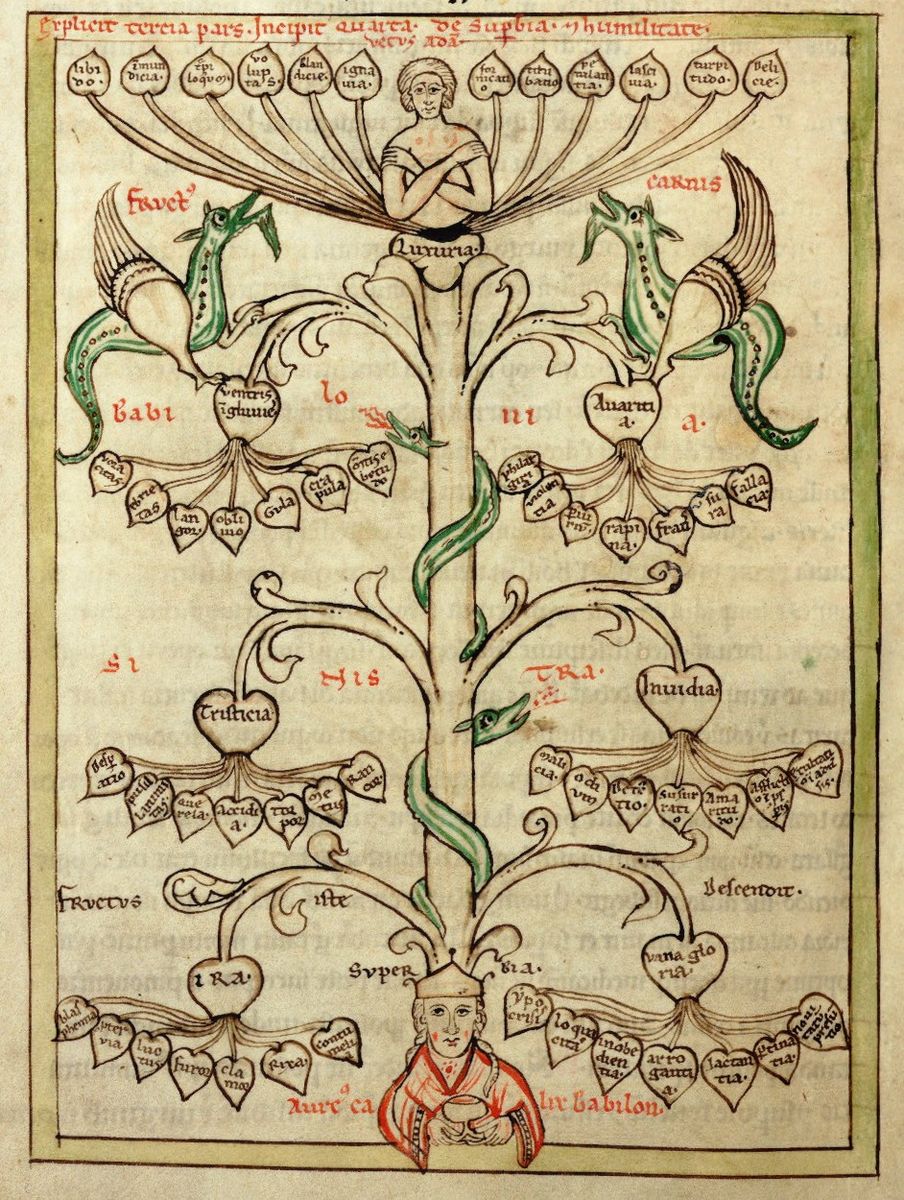
Tree of Vices, Speculum Virginum, Walters Art Museum Ms W72 folio 25v
|
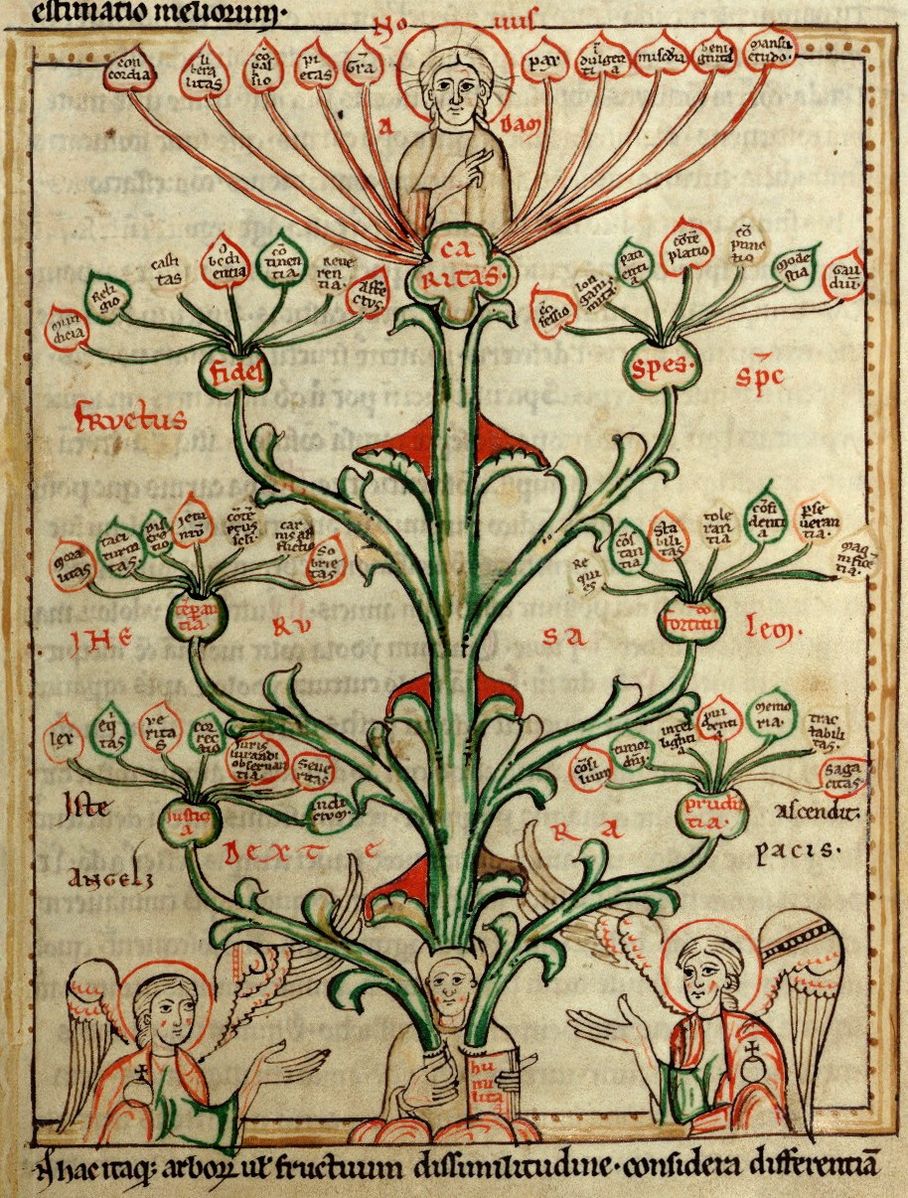
Tree of Virtues, Speculum Virginum, Walters Art Museum Ms W72 folio 26r
|
Book VIII: Conversion
Chapter 1:
Still bound by his need of woman--knew there were those who became eunuchs for the kingdom of heaven, but was not yet himself capable of this … (p.151).
Chapter 2:
Went to Simplicianus (father of Ambrose) and confessed his desire that kept him from conversion; told him he had read the Platonists.
Simplicianus said Platonists were good, they had the word of God therein, but other philosophers were full of fallacies.
Simplicianus conveyed the story of Victorinus—scholar, philosopher, teacher of senators—who converted to Christianity. Initially he was ashamed to go to church, demanding of Simplicianus whether entry beyond its walls made one a Christian? But, he did fear and feel shame for not publicly being Christian and feared that God would deny him. Thus, one day, he asked Simplicianus to take him along to Church and make him a Christian. He goes, publicly converts.
Chapter 3:
“O good God, what is it in men that makes them rejoice more when a soul that has been despaired of and is in very great danger is saved than when there has always been hope and the danger has been so serious?” (154-5).
The victorious general has a triumph, which necessitates that he had a battle; and the more triumphant if the more dangerous a one (155). All emotions seem more powerful when they have more adversity—a man may take women for granted until he has been made to wait, sighing, for one. Why is this God?
Chapter 4:
“… Thou hast chosen the weak things of the world, to confound the strong, and the base things of this world, and the things despised hast Thou chosen, and those things which are not, that Thou mightest bring to nought things that are” (157).
Chapter 5:
Augustine’s Psychology of the Perverse and the Spiritual Will:
- Augustine longs to give himself to religion: “This was just what I longed for myself, but I was held back, and I was held back not by fetters put on me by someone else, but by the iron bondage of my own will. The enemy held my will and made a chain out of it and bound me with it. From a perverse will came lust, and slavery to lust became a necessity. These were like links, hanging each to each (which is why I called it a chain), and they held me fast in a hard slavery” (158).
He longed for God, but this new will was not strong enough against his old will:
- Will one: spiritual
- Will two: carnal
Psychology of Perverse Will:
- Lust is made out of perverse will;
- When one becomes bound to lust, lust becomes habit;
- When lust becomes habit (habit not resisted), lust becomes necessity;
- When lust is a necessity, this is Carnal Will.
“… the flesh lusteth against the spirit and the spirit against the flesh …” (158).
Augustine’s spiritual will conflicts with his carnal will; he has as much fear of being freed from his lust as he had for being lustful.
He likens himself to someone asleep: one doesn’t want to sleep forever, yet it is so hard to awaken… he could sense God calling him to awaken, yet he, like a half-sleep person, wanted to sleep just a little longer (159).
Chapter 6:
In case we were unsure why he wanted to stay asleep, it was because of his bondage of desire for sex… oh, yeah, and fetters to the affairs of the world.
His friend Alypius and he were visited by a man named Ponticianus (from Africa); Ponticianus sees they have a copy of Paul’s writings, he admits he is a baptized Christian. He proceeded to tell them about an Egyptian monk named Antony: two men, friends of Ponticianus, came across the written account of Antony’s life and instantly converted—one paused, reading, felt ful of anxiety and fear, kept reading, and the fear and anxiety faded to peace and resoluteness—and the men dedicated their lives to God; even their fiancés, upon hearing about the men, instantly converted as well.
Chapter 7:
Augustine knew that God was speaking through Ponticianus, showing him to himself: “I could see how foul a sight I was—crooked filthy, spotted, and ulcerous” (164). But, he could still not convert: “Make me chaste and continent, but not yet” (164).
“As Ponticianus went on with his story, I was lost and overwhelmed in a terrible kind of shame” (165).
Chapter 8:
The shame boils over as they sit in the garden together: “My looks were as disordered as my mind as I turned on Alypius and cried out to him: ‘What is wrong with us? What is this which you have just heard? The unlearned rise up and take heaven by force, while we, (look at us!) with all our learning are wallowing in flesh and blood. Is it because they have gone ahead that we are ashamed to follow? And do we feel no shame at not even following at all?’” (165).
He flails about, angered, waiting to see if his will can will him to convert; his will must be resolute and sincere, not twisted like his (166).
Chapter 9:
His mind can easily will the body, but the mind cannot easily will the will to do anything.
Chapter 10:
This duality of will does not mean that humanity has two natures (good and evil). One will (one soul) will feel the same impulses.
Chapter 11:
He feels he is close; the desperate pleading of his vice became a whisper behind his back, asking how he could do without, forever… “I pray you in your mercy to keep such things from the soul of your servant. How filthy, how shameful were these things they were suggesting!” (171).
In contrast, he sees the “chaste dignity of Continence; she was calm and serene, cheerful without wantonness, and it was in truth and honor that she was enticing me to come to her without hesitation, stretching out to receive and to embrace me with those holy hands of hers…” (172).
Chapter 12:
Augustine throws himself under a fig tree and cries. Asking how long? Then, suddenly, he hears the singsong voice of a child repeating “Tolle, lege,” “take it and read it” (173). He cannot fathom this as a game, and understands that it must be a divine command, remembering Antony being led by a passage from the Gospels. So Augustine hurries back to where Alypius was still sitting, picked up the writings of Paul and opened it at random and read (Romans 13:13-14):
- Not in rioting and drunkenness, not in chambering and wantonness, not in strife and envying: but put ye on the Lord Jesus Christ, and make not provision for the flesh in concupiscence (174).
He stopped reading and told Alypius what he had gone through. Alypius told his of his own inner turmoil and asked to read the passage; he read further:
- Him that is weak in the faith, receive (174)
And he applied these words to himself and calmly and resolutely joined Augustine in conversion.
They immediately went from there to tell Monica, Augustine’s mother; this made her happy.
Book IX- The New Catholic
The converted Augustine follows God’s will instead of his own. Abandons his career as a rhetoric teacher since it is a mere selling of words. His son Adeodatus dies at 17 and Augustine is baptized at 387 at age 33. Recalls the life and death of his mother.
The converted Augustine follows God’s will instead of his own. Abandons his career as a rhetoric teacher since it is a mere selling of words. His son Adeodatus dies at 17 and Augustine is baptized at 387 at age 33. Recalls the life and death of his mother.
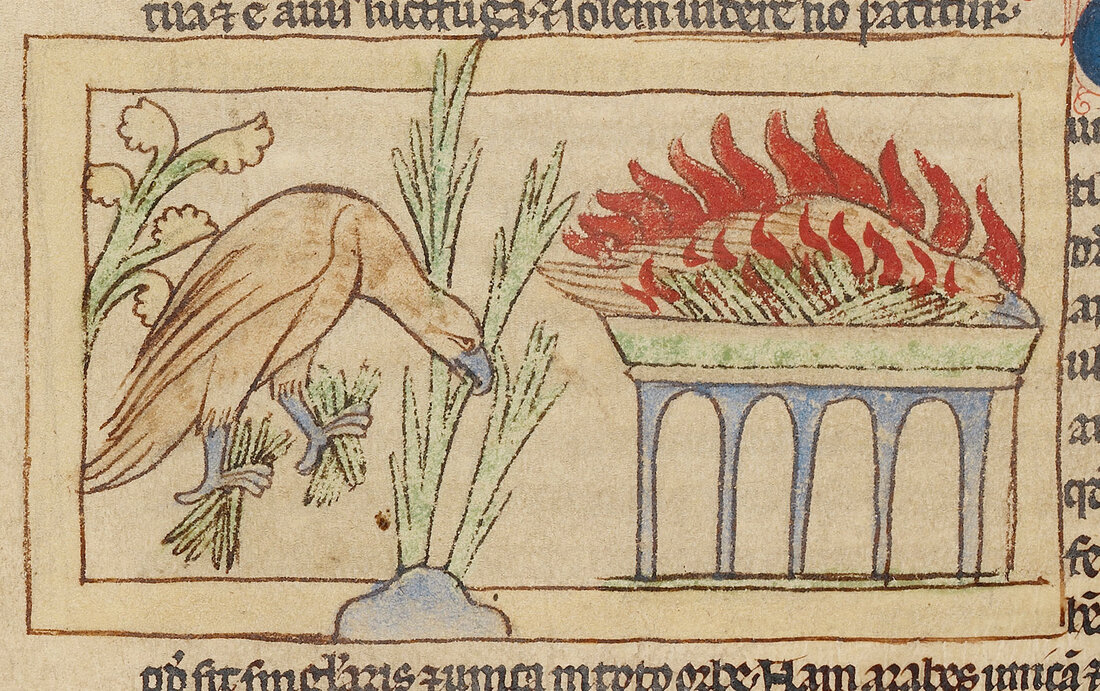
Phoenixes (detail), Northumberland Bestiary, ca. 1250–60; The J. Paul Getty Museum, Los Angeles, Ms. 100, fol. 41v.
Confessions Book X: Memory
- Outline:
- Chs.1-5: Why confession?
- Chs.6-7: Loving and knowing
- Chs.8-9: Treasure house of memory
- Chs.10-12: Knowing and learning
- Chs.13-15: False things and feelings
- Chs.16-19: Forgetting and beyond memory
- Chs.20-24: Happy life
Chapter 1:
“Let me know you, my known, let me know Thee even as I am known” (202).
You love the truth, and coming into the truth is coming into your love; this is what I want my confessions to be, a coming into the truth by my heart and before witnesses in my writings.
Chapter 2:
But isn’t the notion of confession odd to a God who is all knowing? Then, is confession only for the confessor?
- And isn’t this another problem for the question of evil … if God knows all, he knows from the start if we will sin or be good, and –the same question again— did he not create the plan? --see On Free Choice of the Will--
So, my confession is not in words of the flesh, but in words of the soul.
Confession when I am evil is displeasure with myself;
Confession when I am good is attributing my goodness to you (203).
Chapter 3:
Why, then, do I write my confessions (if they are of the soul)?
Self as a relation to God:
Why would people want to read about what I am when they do not want to hear from you what they are? And, how do they know I tell the truth?
- But if they hear from you something about their own selves they cannot say: ‘the Lord is lying.’ For to hear from you about themselves is simply to know themselves. And if one knows oneself and then says: ‘it is false,’ one must be lying oneself (203).
Compare this to chapter ten of book seven:
- I was admonished by all this to return to my own self, and, with you to guide me, I entered into the innermost part of myself, and I was able to do this because you were my helper (VII: Ch.10, p.139).
Remember, that following in the Platonist-mystical tradition, Augustine will reveal that the self is essentially a relation to God: the more we delve into the self, the closer we come to God. And this is true to Plato insofar as philosophy is effective if it provokes the self to take it up unto oneself… Thus, Augustine’s reflection upon his life is movement towards God. Think about the motion that this makes: remember back in order to continually move forward--a hint as to how Augustine conceives of time.
But, to return to the question, why, then, do I write my confessions (if they are of the soul)?
People may not want to read them, he cannot prove he is telling the truth, yet some people will read them, believe them, and will “have their ears opened” (203).
Note that he calls God: “my inmost Physician” (203).
Reading about his past sins rouses the heart and keeps it from sinking into despair; they encourage it to be wakeful and strong.
Everyday his conscience makes confession to God, but “tell me, I beg you, of what advantage it is when, in front of you, I also by means of this book confess to men not what I once was, but what I now am” (204) …in other words… Telling men of his past sins can help give them strength to overcome their own sins and can give Augustine himself renewed strength, but… telling them about who he is now is to tell people not about his words, but about who he is inside, “…beyond the possible reach of their eyes and ears and minds” (204); they want to hear, they are ready to believe, but will they know? ???
What is Augustine asking? Will they know Augustine, or will they know God? The former seems of little consequence in light of the possibility of the latter; so, is Augustine saying that he can serve the role that God served for him and be the voice that helps people convert or remain resolute in faith? But, why add the question “understand,” as a step beyond belief? Can Augustine only be like Ambrose, Simplicius, Antony, and inspire the intellectual turning towards God?
Chapter 4:
To what advantage do they want to listen? Asks Augustine. Rejoice with me? Pray for me? Use me for a model to love what is to be loved and lament what is to be lamented? I hope only the brotherly ones read this.
- So in confessing not only what I have been but what I am the advantage is this: I make confession not only in front of you, in a secret exultation with trembling, with a secret sorrow and with hope, but also in the ears of the believing sons of men, companions in my joy and sharers in my mortality, my fellow citizens and fellow pilgrims—those who have gone before and those who follow after and those who are on the road with me (205).
Chapter 5:
Is a further reflection on knowledge as it relates to the idea of confession and one’s self as a relation to God. God knows him, but he, also, “still I know something of you which I do not know of myself” (206). This prompts him to site First Corinthians about the coming to know:
- For we know in part, and we prophesy in part. But when that which is perfect is come, then that which is in part shall be done away. When I was a child, I spake as a child, I understood as a child, I thought as a child: but when I became a man, I put away childish things. For now we see through a glass, darkly; but then face to face: now I know in part; but then shall I know even as also I am known. And now abideth faith [fides], hope [elpis (to anticipate with pleasure)], charity [agape] these three; but the greatest of these is charity (I Cor. 13:9-13).
He continues, “So I will confess what I know of myself, and I will also confess what I do not know of myself; because what I know of myself I know by means of your light shining upon me and what I do not know remains unknown to me until my darkness be as the noonday in your countenance” (206).
- And if thou draw out thy soul to the hungry, and satisfy the afflicted soul; then shall thy light rise in obscurity, and thy darkness be as the noonday: And the LORD shall guide thee continually, and satisfy thy soul in drought, and make fat thy bones: and thou shalt be like a watered garden, and like a spring of water, whose waters fail not (Is 58:10).
... Interlude ... Re: Chs. 6-19: Augustine establishes a PHILOSOPHY OF MEMORY: Memory as a “treasure house” and “stomach of the mind” stores (digests?, holds without taste?) memories of three kinds / levels:
- 1st level of memory: images (not things-themselves) via senses.
- 2nd level: image of words and what the words signify (things-themselves), e.g., mathematical principles, number, etc. (none perceived by senses); significations may be in memory before he learned them*;
- 3rd level: affections of the mind (joy, sorrow, desire, fear); store their ‘notions’ (not sound, image, or thing-itself), and remember without being them.
- * Hearkens Platonic theory of recollection: all learning is remembering the forms—demonstrated by Socrates, in Plato’s Meno, by working on a geometry problem with a slave boy (never taught math and is more cooperative than Meno) to recollect how to double a square; as he makes a few mistakes and Socrates asks questions to point these out, Socrates then says: “You realize, Meno, what point he has reached in his recollection. At first he did not know … even now he does not yet know, but then he thought he knew, and answered confidently … now he does think himself at a loss, and as he does not know, neither does he think he knows” (Meno, 84a-b). Augustine also establishes with this how the ‘I think’ (cogito) consists, then, in bringing together (cogenda) or collecting (colligenda) (‘collecting’ the ‘scattered’ also key imagery in Neoplatonic emanation theory)—Perhaps all this applicable to Augustine’s search?
Chapter 6:
“But what do I love when I love you?”
“Augustine attempts to find an answer to this question by investigating what there is which is worthy of love, and by asking whether there is something among them which God himself is, or what gives a ‘fulfilling intuition’ if he lives in the love of God, what suffices for, or saturates, that which, in the love of God, he intends. (‘Cum te amo’ [when I love you] already indicates an existential stage here—the stage which has experienced mercy and, in this mercy, has been pulled out of deafness, the stage which can ‘hear’ and see, that is, the stage in which loving, in such loving, is opened up for something definite; and only from here on, in the ‘cum,’ do coelom et terra [heaven and earth] announce God’s praise—not, however, when my attitude is that of natural-scientific research)” (Heidegger, “Augustine and Neo-Platonism,” Early Freiberg Lecture, Summer Semester 1921, in The Phenomenology of Religious Life, trans. Matthias Fritsch and Jennifer Anna Gosetti-Ferencei (Bloomington: Indiana University Press, 2010), 130).
Heidegger captures importantly the idea of loving as an opening up for something (something definite, but something not-yet, perhaps as anticipation—the possibly authentic stance one takes towards one’s ownmost possibility of the impossibility of being, that is, towards one’s own death). Loving, like Heidegger’s Care, is something “lived in;” it is a dispositional stance towards something else, likely, in its connection to desire and lack, towards something not yet, or not had—it is not an emotion one ‘has.’ Also, note how Heidegger’s quick closure keeps open possibility for a rather unorthodox reading of this chapter … let’s build up to this:
Augustine affirms: I do not love the body, the flesh that can be embraced; not the brightness of light, the melodies sung. But … I do love a sort of light, a sort of melody, a sort of fragrance, a sort of food, a sort of an embrace when I love you God, for you are the light, melody, fragrance, food, and embrace of my inner self … but this is a brilliance above all light, a sound never carried away, a perfume whose bouquet never fades, a taste that never dissolves, “a clinging together that no satiety will sunder. This is what I love when I love my God” (X.6, p.207).
Despite his loving a sort of these sensory movements, this does not mean that his love is amongst the things of the world of sensible perception … God is all these things in that He is the excellency in them all (a variant strain of emanation theory’s opening premise that God is all that is), yet He surpasses being any one of these things (which allows transcendence in addition to immanence, saving this from a pantheism; literally, when sur-passing renders God above the ‘top of the soul’ (X.7), necessitating an ascent into and up through the soul to ascend to that which is above, beyond it—which ties to the proof of God’s existence in Bk. II of On Free Choice of the Will wherein the proof treads past reason to be that which reason seeks, eventually truth, which is God, unless there is something higher than truth, then that would be God) … So, Augustine asks:
“And what is this God?”
Poetically, Augustine asks all things what is God?, and all things tell him no, not us …
(Later, the chapter quotes Romans 1:19-23 for a point on understanding, although the Scripture passage continues to reference such inhabitants of the earth as transformed in sinful error by man into the divine, as idols, offering an uglier portrait of how sensory gain of knowledge can lead to error.)
All the things that Augustine asks respond: “He made us”—answering his seeking with a display of their beauty as answer. Heidegger, as quickly as Augustine, assumes: “What should he query? The corporeal world has been gone through already, so ‘melius quod interius’ [what is inward is better]” (Heidegger, “Augustine and Neo-Platonism,” Op. Cit., 131). So, Augustine looks to his own self, and asks, what am I? A man, a body and a soul, one is the outside of me and one the inside: which of these should I use to find God?
But, should he have not listened to the things better? He asked “Interrogatio mea, intention mea” [My questioning with them was my attention to them] (X.6), he asked by giving his attention to them, giving his intending to them, in contemplation, and (I argue) mistook them all; they answered in beauty, “et responsio eorum, species eorum” [and their answer was their beauty]—and, they answered truthfully. Truth, as aletheia, unconcealment.
And, referring back to the opening quotation from Heidegger—(‘Cum te amo’ [when I love you] already indicates an existential stage here—the stage which has experienced mercy and, in this mercy, has been pulled out of deafness, the stage which can ‘hear’ and see, that is, the stage in which loving, in such loving, is opened up for something definite; and only from here on, in the ‘cum,’ do coelom et terra [heaven and earth] announce God’s praise—not, however, when my attitude is that of natural-scientific research)” (Heidegger, “Augustine and Neo-Platonism,” Op. Cit., 130)—love opens one to the not yet; in this opening, heaven and earth announce God’s praise, they say something about God. However, in the natural attitude (the ontic), one cannot hear it. Is Augustine simply not listening?*
Instead of hearing the things’ response in and of their beauty, he continues seeking through contemplation, through reason. He is asking what is it that he loves, when he loves God—the creatures show him beauty. Is it not beauty that beckons love? That calls us to the proper disposition by which to love? Is not God, as the Good, the Beautiful? He turns to reason, instead; he wants his ‘hearing’ to be an ‘understanding,’ a grasping of sense as meaning as something one can have, as opposed to ‘hearing’ ‘sense’ as sensory meaning. But, if the meaning of God is love, and piety is living in this love, how could we have it and not destroy its desire by ceasing a lack?
Augustine moves on and asks, which of these, by the interior or by the exterior, should I use to find God? He decides to proceed by seeking God through his interior because he had already tried to find God by means of the senses, the exterior. The interior is better because it is the processor of all the exterior data: “The inner man knew these things by means of the ministry of the outer man” (X.6, p.208).
Senses alone cannot find God, Augustine affirms, through interaction with the exterior world. Were this the case, all the animals would be capable of fining God, for they can sense, but, humanity has the capacity to reason, and it is through reason that we judge the evidence of the senses and can determine more truthfully matters religious. Humans can ask the question, Augustine says, citing Romans 1:20, of which the whole passage reads:
The appearances do not change, but they do not speak the same answer to all men and women who ask; only to those who look on them prepared to judge do they truly speak; to judge is to “compare the voice which comes to them from outside with the truth that is within” (208).
“But what do I love when I love you?”
“Augustine attempts to find an answer to this question by investigating what there is which is worthy of love, and by asking whether there is something among them which God himself is, or what gives a ‘fulfilling intuition’ if he lives in the love of God, what suffices for, or saturates, that which, in the love of God, he intends. (‘Cum te amo’ [when I love you] already indicates an existential stage here—the stage which has experienced mercy and, in this mercy, has been pulled out of deafness, the stage which can ‘hear’ and see, that is, the stage in which loving, in such loving, is opened up for something definite; and only from here on, in the ‘cum,’ do coelom et terra [heaven and earth] announce God’s praise—not, however, when my attitude is that of natural-scientific research)” (Heidegger, “Augustine and Neo-Platonism,” Early Freiberg Lecture, Summer Semester 1921, in The Phenomenology of Religious Life, trans. Matthias Fritsch and Jennifer Anna Gosetti-Ferencei (Bloomington: Indiana University Press, 2010), 130).
Heidegger captures importantly the idea of loving as an opening up for something (something definite, but something not-yet, perhaps as anticipation—the possibly authentic stance one takes towards one’s ownmost possibility of the impossibility of being, that is, towards one’s own death). Loving, like Heidegger’s Care, is something “lived in;” it is a dispositional stance towards something else, likely, in its connection to desire and lack, towards something not yet, or not had—it is not an emotion one ‘has.’ Also, note how Heidegger’s quick closure keeps open possibility for a rather unorthodox reading of this chapter … let’s build up to this:
Augustine affirms: I do not love the body, the flesh that can be embraced; not the brightness of light, the melodies sung. But … I do love a sort of light, a sort of melody, a sort of fragrance, a sort of food, a sort of an embrace when I love you God, for you are the light, melody, fragrance, food, and embrace of my inner self … but this is a brilliance above all light, a sound never carried away, a perfume whose bouquet never fades, a taste that never dissolves, “a clinging together that no satiety will sunder. This is what I love when I love my God” (X.6, p.207).
Despite his loving a sort of these sensory movements, this does not mean that his love is amongst the things of the world of sensible perception … God is all these things in that He is the excellency in them all (a variant strain of emanation theory’s opening premise that God is all that is), yet He surpasses being any one of these things (which allows transcendence in addition to immanence, saving this from a pantheism; literally, when sur-passing renders God above the ‘top of the soul’ (X.7), necessitating an ascent into and up through the soul to ascend to that which is above, beyond it—which ties to the proof of God’s existence in Bk. II of On Free Choice of the Will wherein the proof treads past reason to be that which reason seeks, eventually truth, which is God, unless there is something higher than truth, then that would be God) … So, Augustine asks:
“And what is this God?”
Poetically, Augustine asks all things what is God?, and all things tell him no, not us …
- “I asked the earth and it answered ‘I am not he,’ and all things on earth confessed the same. I asked the sea and the deeps and the creeping things with living souls, and they replied: ‘We are not your God. Look above us.’ I asked the blowing breezes, and the universal air with all its inhabitants answered: ‘Anaximenes was wrong. I am not God.’ I asked the heaven, the sun, the moon, the stars, and ‘No,’ they said, ‘we are not the God for whom you are looking.’ And I said to all those things which stand about the gates of my senses: ‘Tell me something about Him.’ And they cried out in a loud voice: ‘He made us.’ My question was in my contemplation of them, and their answer was in their beauty” (X, 6, p.207),
(Later, the chapter quotes Romans 1:19-23 for a point on understanding, although the Scripture passage continues to reference such inhabitants of the earth as transformed in sinful error by man into the divine, as idols, offering an uglier portrait of how sensory gain of knowledge can lead to error.)
All the things that Augustine asks respond: “He made us”—answering his seeking with a display of their beauty as answer. Heidegger, as quickly as Augustine, assumes: “What should he query? The corporeal world has been gone through already, so ‘melius quod interius’ [what is inward is better]” (Heidegger, “Augustine and Neo-Platonism,” Op. Cit., 131). So, Augustine looks to his own self, and asks, what am I? A man, a body and a soul, one is the outside of me and one the inside: which of these should I use to find God?
But, should he have not listened to the things better? He asked “Interrogatio mea, intention mea” [My questioning with them was my attention to them] (X.6), he asked by giving his attention to them, giving his intending to them, in contemplation, and (I argue) mistook them all; they answered in beauty, “et responsio eorum, species eorum” [and their answer was their beauty]—and, they answered truthfully. Truth, as aletheia, unconcealment.
And, referring back to the opening quotation from Heidegger—(‘Cum te amo’ [when I love you] already indicates an existential stage here—the stage which has experienced mercy and, in this mercy, has been pulled out of deafness, the stage which can ‘hear’ and see, that is, the stage in which loving, in such loving, is opened up for something definite; and only from here on, in the ‘cum,’ do coelom et terra [heaven and earth] announce God’s praise—not, however, when my attitude is that of natural-scientific research)” (Heidegger, “Augustine and Neo-Platonism,” Op. Cit., 130)—love opens one to the not yet; in this opening, heaven and earth announce God’s praise, they say something about God. However, in the natural attitude (the ontic), one cannot hear it. Is Augustine simply not listening?*
- * “The ‘concepts’ of understanding, and all understanding in the genuinely philosophical sense, have not the slightest to do with rationalization” (Heidegger, “The Philosophical Foundations of Medieval Mysticism,” Outlines and Sketches for a Lecture, Not Held, 1918-19, “Irrationalism,” August 14, 1919, in The Phenomenology of Religious Life, Op. Cit., 236)
Instead of hearing the things’ response in and of their beauty, he continues seeking through contemplation, through reason. He is asking what is it that he loves, when he loves God—the creatures show him beauty. Is it not beauty that beckons love? That calls us to the proper disposition by which to love? Is not God, as the Good, the Beautiful? He turns to reason, instead; he wants his ‘hearing’ to be an ‘understanding,’ a grasping of sense as meaning as something one can have, as opposed to ‘hearing’ ‘sense’ as sensory meaning. But, if the meaning of God is love, and piety is living in this love, how could we have it and not destroy its desire by ceasing a lack?
- Interlude ... in connection, consider Lyotard's remarks on the lusty Saint's search: “Witness. Not memory, then, but the said inner human. … This is the only witness of the presence of the Other, of the other of presence. … The inner human does not bear witness to a fact, to a violent event that it would have seen, that it would have heard, tasted, or touched. It does not give testimony, it is the testimony. … The inner human does not evoke an absence. It is not there for the other; it is the Other of the there, who is there, there where light takes place without place, there where sound resounds without duration” (Jean-François Lyotard, The Confession of Augustine (Stanford: Stanford University Press, 2000), 7-8.
Augustine moves on and asks, which of these, by the interior or by the exterior, should I use to find God? He decides to proceed by seeking God through his interior because he had already tried to find God by means of the senses, the exterior. The interior is better because it is the processor of all the exterior data: “The inner man knew these things by means of the ministry of the outer man” (X.6, p.208).
Senses alone cannot find God, Augustine affirms, through interaction with the exterior world. Were this the case, all the animals would be capable of fining God, for they can sense, but, humanity has the capacity to reason, and it is through reason that we judge the evidence of the senses and can determine more truthfully matters religious. Humans can ask the question, Augustine says, citing Romans 1:20, of which the whole passage reads:
- For the wrath of God is revealed from heaven against all ungodliness and unrighteousness of men, who hold the truth in unrighteousness; Because that which may be known of God is manifest in them; for God hath shewed [it] unto them. For the invisible things of him from the creation of the world are clearly seen, being understood by the things that are made, [even] his eternal power and Godhead; so that they are without excuse: Because that, when they knew God, they glorified [him] not as God, neither were thankful; but became vain in their imaginations, and their foolish heart was darkened. Professing themselves to be wise, they became fools, And changed the glory of the uncorruptible God into an image made like to corruptible man, and to birds, and fourfooted beasts, and creeping things [herpeton, a creeping thing, serpent] (Romans 1:19-23).
The appearances do not change, but they do not speak the same answer to all men and women who ask; only to those who look on them prepared to judge do they truly speak; to judge is to “compare the voice which comes to them from outside with the truth that is within” (208).
Chapter 7:
“What, then, do I love when I love God? Who is He that is the summit of my soul? It is by my soul herself that I shall ascend to Him”—see above note on sur-passing.
There is one force that makes us cling to the body (the animals have this force, too), and this we surpass in our search.
There is another force that gives us perception (the animals have this force, too), and this we also must surpass in our search.
We surpass these forces to the force of memory … but before we turn to this rich chapter, let us understand better what these forces are that we are surpassing …
“What, then, do I love when I love God? Who is He that is the summit of my soul? It is by my soul herself that I shall ascend to Him”—see above note on sur-passing.
There is one force that makes us cling to the body (the animals have this force, too), and this we surpass in our search.
There is another force that gives us perception (the animals have this force, too), and this we also must surpass in our search.
We surpass these forces to the force of memory … but before we turn to this rich chapter, let us understand better what these forces are that we are surpassing …
Interlude: Three Conceptions of Soul:
Augustine’s conception of SOUL is predominately Platonic, but with reference to the Aristotelian ... compare:
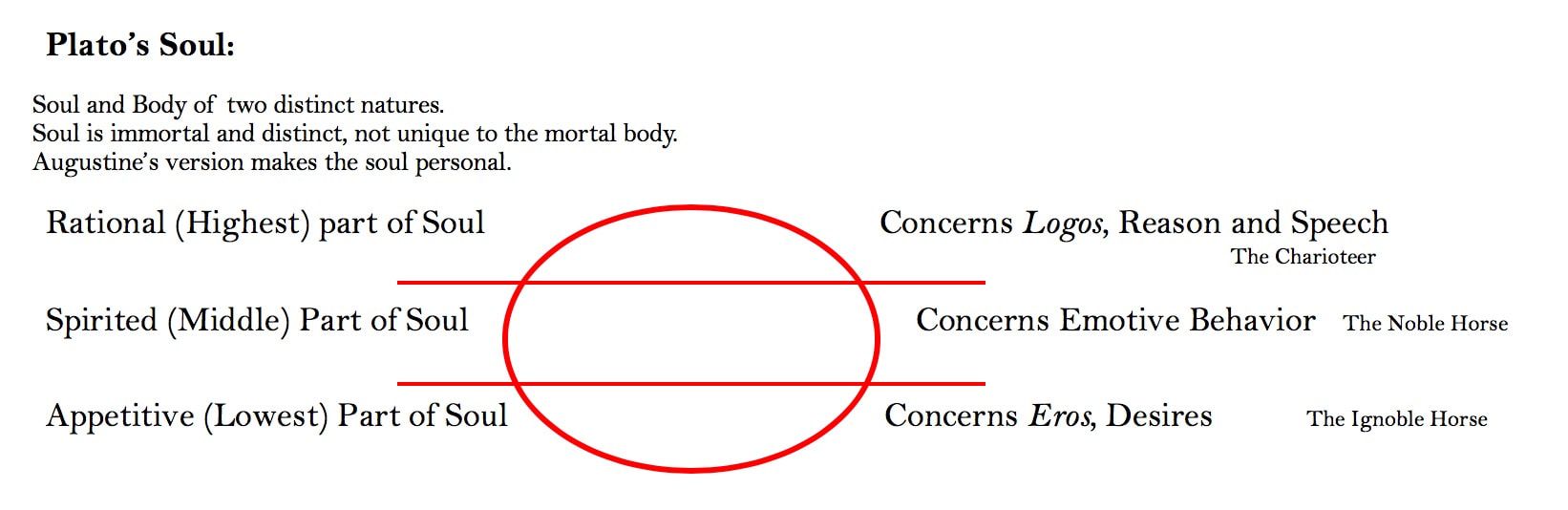
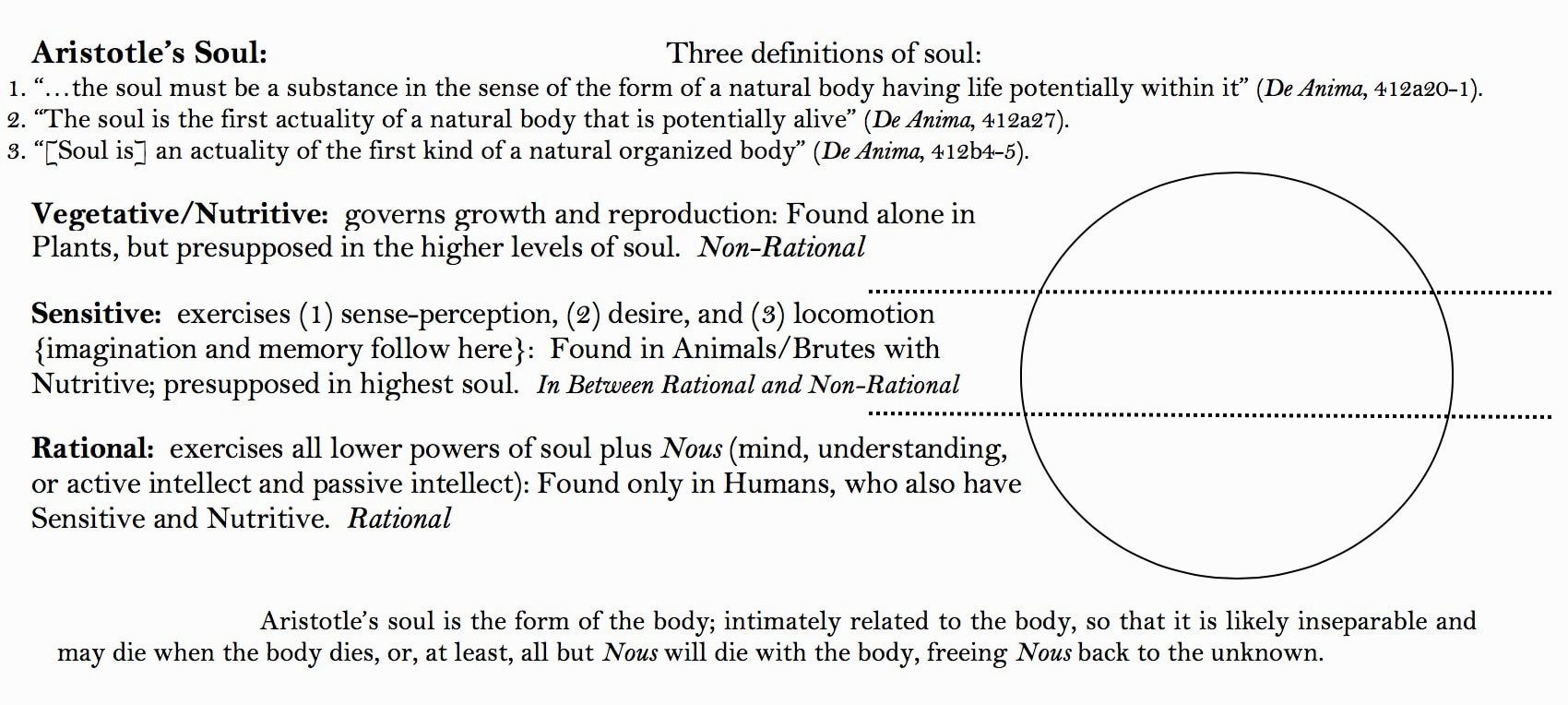
For further comparison ... while Augustine's conception of soul (Platonic with Aristotelian adaptations) became the early Christian model, by the later medieval period, Augustine's model was concretized into that exceedingly detailed by Aquinas:
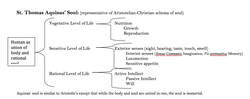
Chapter 8:
Self-knowledge is impossible without God’s help. Sensation cannot allow one to find God since beasts have it too. There is something beyond sensation that gives life to sensation and orders the senses to perform their functions and fulfill their purposes. Sensation cannot explain the organic unity of the body so we need to go beyond it.
We surpass these forces of the appetitive and spirited or nutritive and sensitive to the force of memory… the faculty or “treasure house,” the fields and spacious palaces of memory, within the rational part of the soul.
Here lie the images of everything brought forth by the senses, kept distinct and stored according to classification, for recall later. “Or rather it is not the things themselves that enter; what happens is that the images of things perceived are there ready at hand for thought to recall. Precisely how these images are formed who can tell?” (210).
Their cause is well known, the scents in memory were captured by the nose, but I can recall them by the mind, and ‘smell’ them again even if my nose no longer works because “All this I do inside me, in the huge court of my memory” (211). I also encounter myself in memory; my memory is also temporal: “…I can myself weave them [memories of experiences] into the context of the past, and from them I can infer future actions, though they were in the present” (211). How great is memory!
You may have stood at the base of Mount Kilimanjaro or Mount Moriah and gasped at its height; but I have recalled this and gasped at the memory of what I have not seen as if it were here before me. Does this effect the sublime?
Chapter 9:
And even more is in memory! Think of all the things that are not actual things that we can remember… rules of grammar, arrangements of letters, art of argument… These things too I remember, but I do not store images of them, leaving the things in the exterior world, but, instead, I things themselves are within my treasure house of memory.
Chapter 10:
Chapter 11:
All remembering is re-collecting … collecting up slipped memories.
Augustine, here, is relaying the Platonic Theory of Recollection*: the belief that all is already in us and is merely recollected; knowledge is not created ex nihilo. This theory is the implementation of what we have already discussed, his Theory of Forms (that idea ensured universally communicability because we all had access to those forms), this is the same idea—we recall the Forms.
This same principle of recollection is, in a way, held by the later phenomenologist-existentialist-ontologist, Martin Heidegger: he supplemented Augustine’s explanation of the ready-to-hand (Zuhandenheit; use) with the present-to-hand (Vorhandenheit; stop and think)—note how this is a reversal of our initial ideas about theory and practice where we think then act; this reversal shows that, actually, we live in the world as ready-to-hand, using everything without thought of its being; we are only prompted to theory when things are present-to-hand, when they malfunction and demand us to think of them.
Chapter 12:
Memory also stores principles and laws of numbers and dimensions… though I have no bodily sensation of such.
Chapter 13:
And in my memory I can also truly hold falsity; arguments and their counter arguments. And I can remember the act of remembering.
Chapter 14:
Memory also stores feelings; but, of course, I can remember a feeling without having to re-feel it. I can remember happiness when I am sad and sadness when I am happy. For, the body feels and the mind remembers. “… memory itself is mind” (216).
And when we forget, we say, something slipped my mind. But… how, exactly does this work… does my mind feel the happiness when my memory remembers the sadness, that would suggest that mind and memory are separate:
The four disturbances of mind (desire, joy, fear, sorrow), as well as any of these things, can only be remembered because they are always already in the mind. “…they were there, in the memory, before I recalled them and brought them back; indeed it was only because they were there that I was able to recollect them” (217).
Chapter 15:
But does this recollection take place through images? That is hard to say. When I say “stone” I do not feel a stone, but I do see a stone before my mind’s eye. “I say ‘memory’ and I recognize what I mean by it; but where do I recognize it except in my memory itself? Can memory itself be present to itself by means of its image rather than its reality?” (218).
Chapter 16:
The importance of this last question is revealed because Augustine takes up the question of FORGETFULNESS. We recognize what the word means. But how can we talk about recognizing the thing itself (forgetfulness) without actually remembering it?
Remembering forgetfulness… absurdity! How difficult a question! “Nevertheless… however incomprehensible and inexplicable, I am quite sure that I do remember this forgetfulness by which what we remember is effaced” (220).
Chapter 17:
How great is memory!!! It is ‘I,’ my mind, my memory, but I cannot get to its bottom! “What then am I, my God?” (220).
“I will go past this force of mine called memory; I will go beyond it so that I may draw nearer to you, sweet light” (220). Even animals and birds have memory… so I must also pass beyond this force… (recall he already moved beyond the appetitive and sensitive…)…
“I will pass beyond memory to find you—Oh where, where, shall I find you, my truly good, my certain loveliness? If I find you beyond my memory, I can have no memory of you. And how shall I find you if I do not remember you?” (221).
Recall Book I chapter 1: “How can one pray to you unless one knows you” (1).
Chapter 18:
If you lost a jacket, you would not succeed in finding the jacket unless you remembered (1) that you lost it and wanted to look for it and (2) remembered what it looked like so you could discern if X, Y, or Z was the lost jacket.
“We do not say we have found what was lost unless we recognize it, and we cannot recognize it unless we remember it. It was certainly lost to the eyes, but it was still held in memory” (221-2).
SO … how could we find God if we cannot have a memory of Him? But how can we have a memory of Him unless we have already known him?
Chapter 19:
When we forget, when we ‘lose’ something, we must also remember it so that we can once again find it. So, this is the solution:
And again … “For if we can remember that we have forgotten something, this means that we have no entirely forgotten it. Whatever has been utterly forgotten cannot even be thought of as lost and cannot be sought for” (222-3).
So … in our seeking for God, we must partially remember God …
Chapter 20:
“How, then, Lord, do I seek you? For when I seek you, my God, I am seeking the happy life.”
Isaiah 55:3: “Incline your ear, and come unto me: hear, and your soul shall live; and I will make an everlasting covenant with you…”
Recall how we discussed earlier that Augustine merged Plato’s Good with the Christian God, so that the goal for Plato was the examined life, the good life, and the goal for Augustine is the godly life, the happy life.
But how, he asks, do I seek the happy life? Do I remember the happy life that I have forgotten but still remember somewhat? OR, do I desire the entirely unknown happy life?
Do not all people desire the happy life? But how do they know it, because surely they must have knowledge of it so as to be able to desire it… is this knowledge in memory? When did we once, all of us, experience the happy life? For we could not love it if we did not know it. It is not just the sounds of the words that we love, it is the happy life itself we love:
Chapter 21:
So… what sort of memory do I have of the Happy Life?
So … where and when did I experience the happy life so that I now remember it and desire it? And not just me, but, all of us… How can this be? It seems like what people call the happy life is so diverse, how can we have had a universal experience of such?
Chapter 22:
There is only one happy life: “to rejoice in you and to you and because of you” (226). People may pursue other joys, mistaking it for your joy, but the will that lets us experience the joy is the same for all joy, the same will that takes joy in you.
Chapter 23:
So, does not everyone want to be happy?
But why, then, Augustine asks, do people say that truth gives birth to hatred? Here he is citing Terence’s comedic play Andria which was often used in Latin instruction, which says:
This is posited as a way of revealing why we, the rational creatures, so readily strive for and run from the same thing: the truth. We love it, unless it is something we do not want to hear. For example, why so many of Socrates’ interlocutors ran away from him, they were shown their own ignorance and this is an unpleasant experience.
But, retribution will come to us who flee. We will, one day, be forced to stand before judgment.
Chapter 24:
When I found the truth I loved it, and the truth was you, and I loved you God.
Chapter 25:
But where do you stay in my memory God? You are not material, so you do not rest in the memory I share with the beasts. You are not like an affection per se, so you do not rest in that part of memory. You are not in the mind of my memory, the central seat because you surpass mind itself. You are changeless and above all these things.
Chapter 26:
You dwell in my memory but dwell in such a way that requires no space or time.
Chapter 27:
Like an almost lusty love sonnet to God, Augustine interjects a lament about coming to his love so late and the time he wasted on the beauties God created instead of on God himself.
In Latin:
Chapter 28:
The love sonnet continues … although darker now … he clings to God, a burden to himself since he is not yet united with God.
Is this a comment on human nature: “Is it not true, then, that the life of man upon earth is all trial without intermission?” (230).
Chapter 29:
“For he loves you insufficiently who loves something else with you which he does not love for your sake” (230).
“Grant what you command, and command what you will” (230).
Chapter 30:
Turning towards the commands:
You command me to restrain my flesh and control my lust.
But, I am weak when I sleep.
Chapter 31:
I am weak for the pleasure of food. I need food to survive, thus cannot entirely turn away from it like sex and marriage. So, food is a dangerous kind of pleasure. It is easy to fall into gluttony.
Chapter 32:
The weakness of smell is easier to avoid. I do not miss the pleasant smells when they are gone.
Chapter 33:
The weakness of hearing is harder than smell, but easier than the flesh and food. I am moved by music, but can leave it too. Sometimes, though, I fall for the pleasure of the sounds over the content of hymns, none the less, song in church is good.
Chapter 34:
The weakness of sight is very difficult to overcome. It is a dominant sense. The eyes love beauty; they seek out beauty. And, of course, God made all the beauty that we see, but we cannot be overly attached to these beauties over the beauty that is eternal. Beautiful things made by humanity can be good, of course, but they can corrupt too. Keep me from these snarls of temptation.
Chapter 35:
A far more dangerous temptation is the “lust of the eyes”—and not of sight… but of the eyes when we use seeing as referring to knowing (since we say ‘see how it sounds,’ ‘see how it tastes,’ ‘see how hard it is’). This lusty eye can be understood as either seeking pleasure or seeking curiosity… the latter is particularly dangerous.
Another danger are mere idle thoughts, distractions that pull our minds from contemplation of you, God.*
Chapter 37:
We are also tempted by praise. It is good, but we can have an immoderate liking for it.
In addition to commanding CONTINENCE, you also command JUSTICE:
That we direct our love to certain things, our neighbors, goodness, etc.
Chapter 39:
Vanity is another dangerous temptation.
Chapter 40:
Self-knowledge is impossible without God’s help. I could not have found this truth without your aid.
Chapter 42:
People can easily be ed astray in seeking for you to fall in love with their knowledge, have too much pride, and not find you but fall prey to evil temptations.
Chapter 43:
Jesus is here to help, proof of your immense love for us.
Self-knowledge is impossible without God’s help. Sensation cannot allow one to find God since beasts have it too. There is something beyond sensation that gives life to sensation and orders the senses to perform their functions and fulfill their purposes. Sensation cannot explain the organic unity of the body so we need to go beyond it.
We surpass these forces of the appetitive and spirited or nutritive and sensitive to the force of memory… the faculty or “treasure house,” the fields and spacious palaces of memory, within the rational part of the soul.
Here lie the images of everything brought forth by the senses, kept distinct and stored according to classification, for recall later. “Or rather it is not the things themselves that enter; what happens is that the images of things perceived are there ready at hand for thought to recall. Precisely how these images are formed who can tell?” (210).
Their cause is well known, the scents in memory were captured by the nose, but I can recall them by the mind, and ‘smell’ them again even if my nose no longer works because “All this I do inside me, in the huge court of my memory” (211). I also encounter myself in memory; my memory is also temporal: “…I can myself weave them [memories of experiences] into the context of the past, and from them I can infer future actions, though they were in the present” (211). How great is memory!
- Yet, this is a faculty of mind and belongs to my nature; nor can I myself grasp all that I am. Therefore, the mind is not large enough to contain itself. But where can that uncontained part of it be? Is it outside itself and no inside? In that case, how can it fail to contain itself? At this thought great wonder comes over me; I am struck dumb with astonishment (212).
You may have stood at the base of Mount Kilimanjaro or Mount Moriah and gasped at its height; but I have recalled this and gasped at the memory of what I have not seen as if it were here before me. Does this effect the sublime?
Chapter 9:
And even more is in memory! Think of all the things that are not actual things that we can remember… rules of grammar, arrangements of letters, art of argument… These things too I remember, but I do not store images of them, leaving the things in the exterior world, but, instead, I things themselves are within my treasure house of memory.
Chapter 10:
- "These things are those that may be expressed in words, the sounds of which fade away and so I take an image of them for memory, but the things themselves, questions of that it is, what it is, and how it is, I keep as things themselves in mind because I came to them through the mind alone" (213).
Chapter 11:
- "We find, therefore, that to learn those things which we do not draw into us as images by means of our senses, but which we perceive inside ourselves as they actually are without the aid of images means simple this: by the act of thought we are, as it were, collecting together things which the memory did contain, though in a disorganized and scattered way, and by giving them our close attention we are arranging for them to be stored up ready to hand in that same memory where previously they lay hidden, neglected, and dispersed, so that now they will readily come forward to the mind that has become familiar with them" (214).
All remembering is re-collecting … collecting up slipped memories.
Augustine, here, is relaying the Platonic Theory of Recollection*: the belief that all is already in us and is merely recollected; knowledge is not created ex nihilo. This theory is the implementation of what we have already discussed, his Theory of Forms (that idea ensured universally communicability because we all had access to those forms), this is the same idea—we recall the Forms.
- * In Meno, Socrates, to prove the myth of recollection, works with a slave boy (who is more cooperative than Meno) to recollect how to double the square. First, the slave boy doubles the side to double the square. Socrates shows him the mistake. The boy triples side. This again is wrong. (Notice the parallel to the larger conversation with Meno: Socrates: “You realize, Meno, what point he has reached in his recollection. At first he did not know … even now he does not yet know, but then he thought he knew, and answered confidently … now he does think himself at a loss, and as he does not know, neither does he think he knows” (84a-b)). Socrates shows the boy the diagonal that doubles the square. A skeptic may ask whether Socrates really proves that learning is recollection?, and argue that the answers were the boy’s own in the sense that he believed them, though not in the sense that he originated them out of his own soul--nonetheless, he does start to come to see for himself how to do it.
This same principle of recollection is, in a way, held by the later phenomenologist-existentialist-ontologist, Martin Heidegger: he supplemented Augustine’s explanation of the ready-to-hand (Zuhandenheit; use) with the present-to-hand (Vorhandenheit; stop and think)—note how this is a reversal of our initial ideas about theory and practice where we think then act; this reversal shows that, actually, we live in the world as ready-to-hand, using everything without thought of its being; we are only prompted to theory when things are present-to-hand, when they malfunction and demand us to think of them.
Chapter 12:
Memory also stores principles and laws of numbers and dimensions… though I have no bodily sensation of such.
Chapter 13:
And in my memory I can also truly hold falsity; arguments and their counter arguments. And I can remember the act of remembering.
Chapter 14:
Memory also stores feelings; but, of course, I can remember a feeling without having to re-feel it. I can remember happiness when I am sad and sadness when I am happy. For, the body feels and the mind remembers. “… memory itself is mind” (216).
And when we forget, we say, something slipped my mind. But… how, exactly does this work… does my mind feel the happiness when my memory remembers the sadness, that would suggest that mind and memory are separate:
- "Obviously one cannot say that. Therefore the memory must be, as it were, the stomach of the mind, and happiness and sadness like sweet and bitter food, and when they are committed to the memory it is as though they passed into the stomach where they can be stored up but cannot taste. A ridiculous comparison, perhaps, and yet there is some truth in it" (217).
The four disturbances of mind (desire, joy, fear, sorrow), as well as any of these things, can only be remembered because they are always already in the mind. “…they were there, in the memory, before I recalled them and brought them back; indeed it was only because they were there that I was able to recollect them” (217).
Chapter 15:
But does this recollection take place through images? That is hard to say. When I say “stone” I do not feel a stone, but I do see a stone before my mind’s eye. “I say ‘memory’ and I recognize what I mean by it; but where do I recognize it except in my memory itself? Can memory itself be present to itself by means of its image rather than its reality?” (218).
Chapter 16:
The importance of this last question is revealed because Augustine takes up the question of FORGETFULNESS. We recognize what the word means. But how can we talk about recognizing the thing itself (forgetfulness) without actually remembering it?
- "When I remember memory, memory itself is, through itself, present to itself; but when I remember forgetfulness, there are present both memory and forgetfulness—memory by which I remember, forgetfulness which I remember. But what is forgetfulness except privation of memory? How then can it be present for me to remember it, when I am not able to remember it when it is present?" (218-9).
Remembering forgetfulness… absurdity! How difficult a question! “Nevertheless… however incomprehensible and inexplicable, I am quite sure that I do remember this forgetfulness by which what we remember is effaced” (220).
Chapter 17:
How great is memory!!! It is ‘I,’ my mind, my memory, but I cannot get to its bottom! “What then am I, my God?” (220).
“I will go past this force of mine called memory; I will go beyond it so that I may draw nearer to you, sweet light” (220). Even animals and birds have memory… so I must also pass beyond this force… (recall he already moved beyond the appetitive and sensitive…)…
“I will pass beyond memory to find you—Oh where, where, shall I find you, my truly good, my certain loveliness? If I find you beyond my memory, I can have no memory of you. And how shall I find you if I do not remember you?” (221).
Recall Book I chapter 1: “How can one pray to you unless one knows you” (1).
Chapter 18:
If you lost a jacket, you would not succeed in finding the jacket unless you remembered (1) that you lost it and wanted to look for it and (2) remembered what it looked like so you could discern if X, Y, or Z was the lost jacket.
“We do not say we have found what was lost unless we recognize it, and we cannot recognize it unless we remember it. It was certainly lost to the eyes, but it was still held in memory” (221-2).
SO … how could we find God if we cannot have a memory of Him? But how can we have a memory of Him unless we have already known him?
Chapter 19:
When we forget, when we ‘lose’ something, we must also remember it so that we can once again find it. So, this is the solution:
- "… the whole thing had not slipped fro our memory; part of it was retained and by means of this part the other part was sought for, because the memory realized that it was not carrying along with it the totality which it was used to and, going unevenly, as it were, through the loss of something to which it was accustomed, eagerly demanded the restoration of what was lacking" (222).
And again … “For if we can remember that we have forgotten something, this means that we have no entirely forgotten it. Whatever has been utterly forgotten cannot even be thought of as lost and cannot be sought for” (222-3).
So … in our seeking for God, we must partially remember God …
- Interlude: Re: Chs. 20-24, “… the unexamined life is not worth living …” (Plato, Apology, 38a).
Chapter 20:
“How, then, Lord, do I seek you? For when I seek you, my God, I am seeking the happy life.”
Isaiah 55:3: “Incline your ear, and come unto me: hear, and your soul shall live; and I will make an everlasting covenant with you…”
Recall how we discussed earlier that Augustine merged Plato’s Good with the Christian God, so that the goal for Plato was the examined life, the good life, and the goal for Augustine is the godly life, the happy life.
But how, he asks, do I seek the happy life? Do I remember the happy life that I have forgotten but still remember somewhat? OR, do I desire the entirely unknown happy life?
Do not all people desire the happy life? But how do they know it, because surely they must have knowledge of it so as to be able to desire it… is this knowledge in memory? When did we once, all of us, experience the happy life? For we could not love it if we did not know it. It is not just the sounds of the words that we love, it is the happy life itself we love:
- "It is therefore known to all of them, and if they could all be asked with one voice: ‘Do you wish to be happy?’ they would without any doubt reply, ‘We do.’ And this would not be so unless the thing itself, signified by the word, was contained in their memory" (224).
Chapter 21:
So… what sort of memory do I have of the Happy Life?
- Is it a memory like that of Carthage?
- No. The happy life is not a body we can see.
- Is it a memory like that of numbers?
- No. We can be content with numbers, they do not generate in us the desire to seek it; those who know the happy life seek out the happy life necessarily.
- Is it a memory like that of eloquence?
- No. Although, this is close. Mainly the desire generated in us to be eloquent is born out of experiencing the eloquence of others, and, concerning the happy life, we cannot experience the life of another.
- Is it a memory like that of joy?
- Yes, more than likely. Like how I can remember my joy when I am sad, I can remember the happy life when my life is unhappy. I do not sense joy, just as I do not sense the happy life.
So … where and when did I experience the happy life so that I now remember it and desire it? And not just me, but, all of us… How can this be? It seems like what people call the happy life is so diverse, how can we have had a universal experience of such?
Chapter 22:
There is only one happy life: “to rejoice in you and to you and because of you” (226). People may pursue other joys, mistaking it for your joy, but the will that lets us experience the joy is the same for all joy, the same will that takes joy in you.
Chapter 23:
So, does not everyone want to be happy?
- Or do all men really desire it, but because the flesh lusteth against the Spirit and the Spirit against the flesh, that they cannot do what they would, they fall into that state which is within their powers and are content with it because their will for a state which is beyond them is not strong enough to bring it within their reach? (226).
But why, then, Augustine asks, do people say that truth gives birth to hatred? Here he is citing Terence’s comedic play Andria which was often used in Latin instruction, which says:
- “Hoc tempore obsequium amicos, veritas odium parit;” “In these days friends are won through flattery, the truth gives birth to hate” (Terence, Andria).
This is posited as a way of revealing why we, the rational creatures, so readily strive for and run from the same thing: the truth. We love it, unless it is something we do not want to hear. For example, why so many of Socrates’ interlocutors ran away from him, they were shown their own ignorance and this is an unpleasant experience.
But, retribution will come to us who flee. We will, one day, be forced to stand before judgment.
Chapter 24:
When I found the truth I loved it, and the truth was you, and I loved you God.
Chapter 25:
But where do you stay in my memory God? You are not material, so you do not rest in the memory I share with the beasts. You are not like an affection per se, so you do not rest in that part of memory. You are not in the mind of my memory, the central seat because you surpass mind itself. You are changeless and above all these things.
Chapter 26:
You dwell in my memory but dwell in such a way that requires no space or time.
Chapter 27:
Like an almost lusty love sonnet to God, Augustine interjects a lament about coming to his love so late and the time he wasted on the beauties God created instead of on God himself.
In Latin:
- sero te amavi, pulchritudo tam antiqua et tam nova, sero te amavi! et ecce intus eras et ego foris, et ibi te quaerebam, et in ista formosa quae fecisti deformis inruebam. mecum eras, et tecum non eram. ea me tenebant longe a te, quae si in te non essent, non essent. vocasti et clamasti et rupisti surditatem meam; coruscasti, splenduisti et fugasti caecitatem meam; fragrasti, et duxi spiritum et anhelo tibi; gustavi et esurio et sitio; tetigisti me, et exarsi in pacem tuam (X, 27).*
- * amavi: The imagery here is erotic, but much less explicitly so than, e.g., sol. 1.13.22, ‘nunc illud quaerimus, qualis sis amator sapientiae, quam castissimo conspectu atque complexu nullo interposito velamento quasi nudam videre ac tenere desideras, qualem se illa non sinit, nisi paucissimis et electissimis amatoribus suis’ (http://www.stoa.org/hippo/frames10.html).
Chapter 28:
The love sonnet continues … although darker now … he clings to God, a burden to himself since he is not yet united with God.
Is this a comment on human nature: “Is it not true, then, that the life of man upon earth is all trial without intermission?” (230).
Chapter 29:
“For he loves you insufficiently who loves something else with you which he does not love for your sake” (230).
“Grant what you command, and command what you will” (230).
Chapter 30:
Turning towards the commands:
You command me to restrain my flesh and control my lust.
But, I am weak when I sleep.
Chapter 31:
I am weak for the pleasure of food. I need food to survive, thus cannot entirely turn away from it like sex and marriage. So, food is a dangerous kind of pleasure. It is easy to fall into gluttony.
Chapter 32:
The weakness of smell is easier to avoid. I do not miss the pleasant smells when they are gone.
Chapter 33:
The weakness of hearing is harder than smell, but easier than the flesh and food. I am moved by music, but can leave it too. Sometimes, though, I fall for the pleasure of the sounds over the content of hymns, none the less, song in church is good.
Chapter 34:
The weakness of sight is very difficult to overcome. It is a dominant sense. The eyes love beauty; they seek out beauty. And, of course, God made all the beauty that we see, but we cannot be overly attached to these beauties over the beauty that is eternal. Beautiful things made by humanity can be good, of course, but they can corrupt too. Keep me from these snarls of temptation.
Chapter 35:
A far more dangerous temptation is the “lust of the eyes”—and not of sight… but of the eyes when we use seeing as referring to knowing (since we say ‘see how it sounds,’ ‘see how it tastes,’ ‘see how hard it is’). This lusty eye can be understood as either seeking pleasure or seeking curiosity… the latter is particularly dangerous.
Another danger are mere idle thoughts, distractions that pull our minds from contemplation of you, God.*
- * (For an incredible analysis of this "noonday demon" of distraction due sloth, cf. the first several chapters in Giorgio Agamben, Stanzas: Word and Phantasm in Western Culture, trans. Ronald L. Martinez (Minneapolis: University of Minnesota Press, 1993).)
Chapter 37:
We are also tempted by praise. It is good, but we can have an immoderate liking for it.
In addition to commanding CONTINENCE, you also command JUSTICE:
That we direct our love to certain things, our neighbors, goodness, etc.
Chapter 39:
Vanity is another dangerous temptation.
Chapter 40:
Self-knowledge is impossible without God’s help. I could not have found this truth without your aid.
Chapter 42:
People can easily be ed astray in seeking for you to fall in love with their knowledge, have too much pride, and not find you but fall prey to evil temptations.
Chapter 43:
Jesus is here to help, proof of your immense love for us.
Interlude: Reading Confessions through Book X (on Memory) & Book XI (on Time):
The Quest to Know God: Confessions as its preeminent examination as a work thoroughly delineating & embodying the knowing, the act of seeking this knowledge:
“How can one pray to you unless one knows you” (I.1). “And how shall I find you if I do not remember you?” (X.17).
The Quest to Know God: Confessions as its preeminent examination as a work thoroughly delineating & embodying the knowing, the act of seeking this knowledge:
- Bks. I-IX: Present time of things past: Memory of Past: Conversion journey from infancy to age 33
- Bk. X: Present time of things present: Intuition of Present: Current difficulty recalling past events & discussion of memory
- Bks. XI-XIII: Present time of things future: Expectation of Future: On time and eternity & exegesis on Genesis
“How can one pray to you unless one knows you” (I.1). “And how shall I find you if I do not remember you?” (X.17).
Book XI: TIME:
Chs.1-3: Why confession?
Ch.2: So much to know/declare, but “drops of my time are too precious” (p.252)
Ch.3: How understand not just words/ideas, but that they are true
Chs.3-13: Creation; differentiation of eternity and time
Chs.3-4: The question of time is important since God is said to have created the world out of nothing and the question arises about what God was doing before he created the universe? Was there time already? It seems that not? But then where was God?
Ch.5: Divine creation “not like a craftsman” (p.255)--i.e., God created not as artist (vs. demiurge in Timaeus)--but ex nihilo
Ch.6: Creation as unique speaking--divine creation ex nihilo is by His Word ... He spoke & world was created. The Word is spoken eternally; no part of the Word could be changed by being succeeded by another since some parts of it would cease to exist; thus: the word has no parts at all. God’s Word is uttered once & forever, but creation not simultaneous ... Skeptical objection to creation ex nihilo: God must have changed if at one point he decided to create whereas before he was not. So is God eternal or temporal?
Ch.7: “all things are said together and eternally. … So it is by a word coeternal with you that you say, together and eternally, all that you say, and everything is made that you say is to be made. Yet all the things which you make by saying are not made together and eternally” (p.257).
Ch.11: Time and eternity not comparable; time passes, eternity is pure presence
Ch.13: There is no time before time was created
Chs.14: What is time?
Chs.15-16: Long/Short times; Present
- Q.1) why is “the time past was long” illogical?
- Q.2) why is “that particular present time was long” illogical?
- Q.3 why is ‘that future time will be long” illogical?
- Q.4) what is the present and what is extension?
Chs.17-20: Re-think past-present-future as modalities of the present
- Q.5) if past, present, and future exist, where do they exist?
- Q6) how do past, present, and future exist?
Chs.21-28: How could one measure w/o extension?
Chs.21-22: How could one measure w/o extension?
- Q.7) why is extension needed to measure?
- Q.8) why are motions of planets or bodies not time?
- Q.9) rejecting motion, time must be “an extension of some sort” (p.271), so how do the two types of voices show its ‘extension’ (extending out) as a ‘distension’ (expanding within)?
- Q.10) How does the recitation of a psalm show how time is a distension?
Chs.29-31: Return back to God and Time relation
“Witness. Not memory, then, but the said inner human. … This is the only witness of the presence of the Other, of the other of presence. … The inner human does not bear witness to a fact, to a violent event that it would have seen, that it would have heard, tasted, or touched. It does not give testimony, it is the testimony. … The inner human does not evoke an absence. It is not there for the other; it is the Other of the there, who is there, there where light takes place without place, there where sound resounds without duration”
(Jean-François Lyotard, The Confession of Augustine (Stanford: Stanford University Press, 2000), 7-8).
(Jean-François Lyotard, The Confession of Augustine (Stanford: Stanford University Press, 2000), 7-8).
5) Key Ideas and Questions
Augustine’s Confessions: key ideas and questions
Key Ideas & Questions:
Key Text Selections for Exceeding Close Textual Analysis:
More Broadly Theoretical Questions:
Key Ideas & Questions:
- In what ways is Confessions’ form—autobiography, confession, testimony, account of conversions, stylistic intertwining of Scripture, personal narrative, and philosophical argument, etc.—related to its content?
- (e.g., how does getting to know the self parallel getting to know God?; ‘confession’ means both an admitting of crime and a profession of faith, so how is an admittance of sins and of one’s faith parallel his philosophical inquiries into/expositions on God’s nature; how does the book’s passionate, almost melodramatic voice reflect an instruction for the search for knowing the self and God; etc.)
- For whom and to whom is it written? For what is it written (what is its purpose)?
- (e.g., is Augustine’s audience himself, God, other faithful people, others seeking faith, etc.?; when and where and why is it for someone who might differ from whom he seems to be directly addressing?; is its purpose to be an admission of sins therefore seeking forgiveness, is it an act of atonement, is it an exercise of faith, is it a philosophical exercise, is it mean to praise God, is it meant to convert people, or to aid or comfort people, is it meant to educate people, is it simply art for art’s sake, etc.?)
- What is the relationship between reason (knowledge) and belief (faith)?
- (e.g., the ancient Greeks held reason to be eternal and belief to be changeable whereas the later but early Christians held faith to be eternal and knowledge to be changeable—how does Augustine uphold and vary from either position?)
- Mereology
- (e.g., what are textual examples of this study of parts (the many) and wholes (the one)?, why is this type of reasoning used?, what type of questions is it used for?, how does it relate to emanation theory?, etc.)
- Emanation Theory
- (e.g., what is this theory of creation?, where and why and how is it used in the text?, what does it allow us to then know?, etc.)
- Theodicy; The Problem of Evil
- (e.g., how does the existence of evil create logical problems for the Abrahamic notion of an omnibenevolent, omniscient, and omnipotent God?, how does Augustine’s life give examples of everyday, philosophical, and spiritual confrontations with the problem of evil?, what are textually offered possible answers to the question of what is sin/evil, what is its nature, what is its origin?, how do books II and VII similarly and differently answer those questions?, etc.)
- Memory
- (e.g., Confessions begins by asking “How can I seek you God if I do not remember you?”, books I to IX are about Augustine remembering and telling of his past, and book X is a philosophical investigation into the nature, functioning, and limits of memory—how does memory connect to what Confessions is and is about?, what is his philosophy of memory?, how does memory relate to his religious journey?, relate to his journey through life?, what is the memory of forgetfulness?, how does this speak more broadly to the text’s message and themes?, etc.)
- Speaking & Silence
- (e.g., speech and silence broadly writ (speaking, communication, language, response and non-response, meditative silence, silence that says something, silence as abandonment, hearing and not-hearing, listening and not-listening, etc.) occur frequently throughout the text—what are examples?, what examples show the diversity of types of speech and silence?, how do these ideas say something about the text’s philosophical and religious messages?, etc.)
- Psychology of the Will
- (e.g., how does free will, in book VII, play into the account of evil?, what is Augustine’s psychology of the perverse and spiritual wills, in book VIII, help him understand himself and his quest for conversion?, how and why does he reject the notion of these two wills?, how does the dualism of wills compare to and contrast with Manichaean ideas?, what is useful and what is not in this account of will?, etc.)
- Testimonies
- (e.g., prior to Augustine’s conversion, esp. book VIII, he experiences and importantly recounts a number of different conversion stories—what are these, what do they say about the quest for God, about Augustine’s own path?, how do they compare or differ from Augustine’s own conversion(s) story(s)?, etc.)
- What is God
- (e.g., each book gives us questions, descriptions, and accounts of God—what are these, what validates them or how did he come to know these things?, why is it important for Augustine to know what God is?; in book X, to whom does he turn to ask about the nature of God?, what does he investigate there as possible answers?, does he come to a firm answer?, how does it relate to his life’s quest for God?, to his philosophy of memory?, etc.)
- What is time
- (e.g., being an autobiography, the narration of his time is key, but why does book XI directly address the question of time?, how does time say something about God, faith, conversion?, what is his philosophy of time?, etc.)
Key Text Selections for Exceeding Close Textual Analysis:
- Bk. I, chs. 1, 3
- Bk. II, chs. 1, 4
- Bk. VII, chs. 5, 12
- Bk. VIII, chs. 5, 12
- Bk. X, chs. 6, 17, 19, 20
More Broadly Theoretical Questions:
- (1) Textual Form/Nature: What is autobiography? Confession? How is Confessions both autobiography and confession—is it part X, part Y; fully both; neither; a synthesis into something new; etc.? How is the work testimony? Who is the one who testifies, to whom does he testify, about what does he testify, why does he testify? How do ideas about testimony aid or complicate those about it as an autobiography and confession?
- (2) Faith/Reason: As a philosopher-theologian writing when definitions of belief and knowledge were changing (e.g., Greek “knowledge:” eternal universals, “belief:” changeable opinions of worldly things; Christian “knowledge:” of demonstrable worldly things, “belief:” of eternal universals), whose book seeks to know God and have faith via poetic passion and rigorous reason—the knowledge-belief interplay is of utmost importance. What evidence best shows his reliance on knowledge, on belief, and on their combination? How can their combination work if premises, approaches, and consequences of each threaten to invalidate the other? Does his combination of them work?
- (3) Memory/Time: Confessions doesn’t end when he gets to his present time; instead, he talks about memory (Bk.X) and time (Bk.XI)—why? How does memory and time play a role throughout the whole book? How do you understand and evaluate the claim: ‘Confessions itself, in full, represents a demonstration of the content of Books X-XI’?
- (4) Pears/Evil: Stealing pears (Bk.II) exemplifies/invokes issues of sin, its motivations, good and evil, passion, anxiety, and a torturous demonstration of the difficulty of thinking through such issues. What are the many possible explanations he proposes for why he sinned? He claims to have no answer, but is every possibility ruled out, does he favor any possibilities, do you think he might have an answer? Is there pedagogic benefit to the excess and lack of answers? Why this sin (stealing pears) here (in the storyline)? In Bk.VII he defines evil as nothing, a lack—how do you understand this, and does this retrospectively affirm or deny any of the possibilities for sin explored in the pear theft?